Pick a line to follow. Start with an edge of Hawkwood’s pedestal, a lance at San Romano or the dragon’s leash. See where each leads.
Constructing space · The human figure · Reinventing Antiquity
Vers 1397–1475 · Florence, Venise, Prato, Padoue
Paolo Uccello gives his scenes depth while preserving their strangeness.
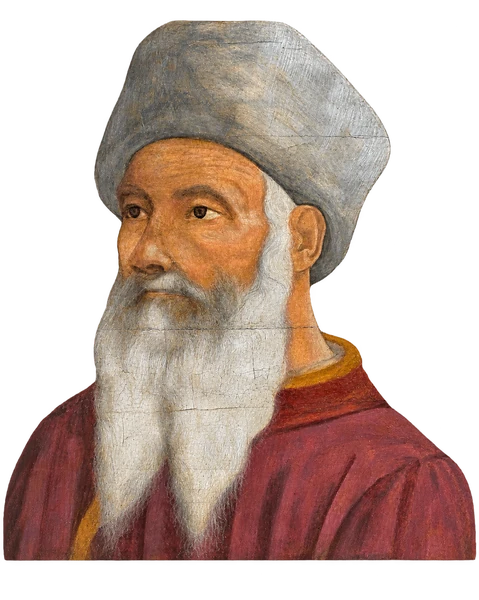
In Paolo Uccello’s paintings, lines draw you into the scene, and the longer you look, the stranger it seems.
A Florentine painter trained in Ghiberti’s workshop, Uccello worked at a time when artists were finding new ways to show depth. He used these discoveries to play with the way we see. How do his lines draw us into scenes whose shapes, colours or stories keep surprising us?
Pick a line to follow. Start with an edge of Hawkwood’s pedestal, a lance at San Romano or the dragon’s leash. See where each leads.
Constructing space · The human figure · Reinventing Antiquity
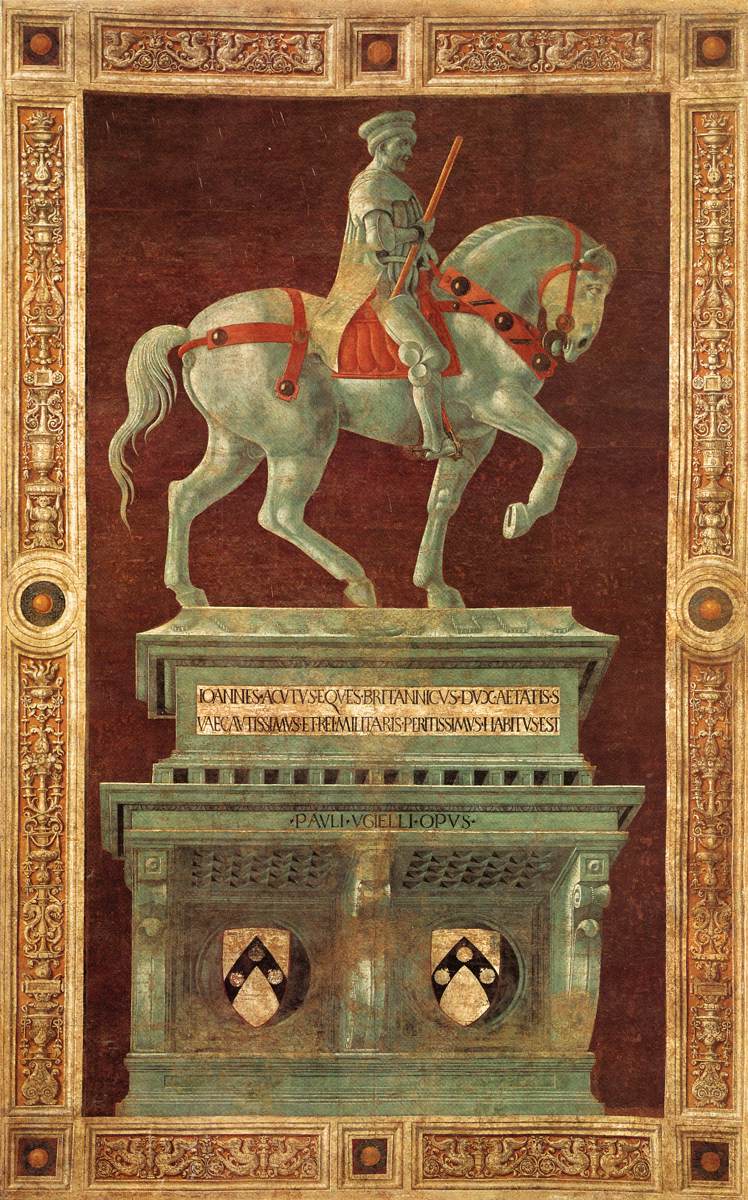
The red lines follow the cornices whose undersides we can see. The sarcophagus appears to sit above us: the viewer looks upwards.
The horse and rider are shown as though we were facing the monument at their height. They are in profile, without the low viewpoint of the sarcophagus. The contrast between these viewpoints makes the illusion distinctive.
At the bottom of the fresco, find the edges of the pedestal. You can see the underside of the mouldings, as though looking up at them. Now move up to the horse and rider. Their outlines are almost as clear as silhouettes seen from the side.
Uccello combines two viewpoints. Seeing the underside of the pedestal places you at the foot of the monument. Above it, the side view lets you make out the horse’s back, the rider’s torso and the line of the baton in his hand. Together, these views make a flat painting look like a monument in relief. The commission honoured John Hawkwood, known in Italy as Giovanni Acuto, a commander in Florence’s service.
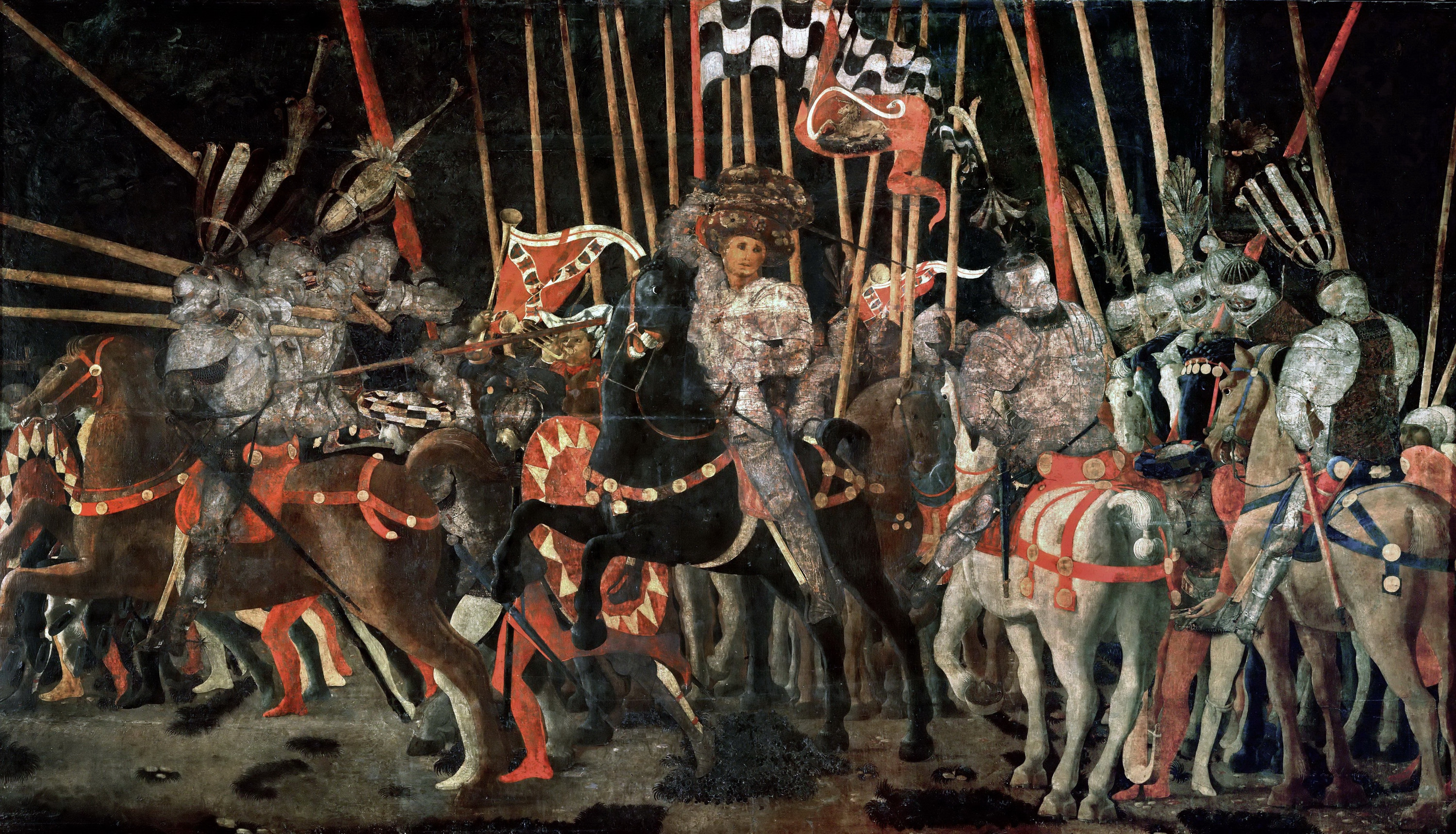
At the centre, the white circle marks Micheletto’s uncovered face. He stands out from the helmeted soldiers. Look at his expression: it may seem enigmatic, although we cannot assign a definite emotion to it.
The green frames mark armour and ornaments where you can look for the shine of silver and gold. Uccello combined silver and gold leaf. These guides show where to look; they do not map the surviving materials.
The blue frames isolate two horses’ heads seen at an angle. The lines emphasise their oblique positions: their heads and bodies extend into depth rather than remaining in profile. Together with overlapping forms, these directions suggest several planes. Compare them with the horses on the left. The lines guide the eye; they are not calculated vanishing lines.
The white lines follow several lances: almost horizontal on the left, upright in the centre, slanting on the right. Their rhythm visually organises the charge.
Find Micheletto’s uncovered face among the helmets at the centre. Now look up at the lances. Some stand upright near him, while others lean to the right. On that side, look for horses’ heads shown at an angle and see which ones overlap.
Micheletto’s face gives your eye somewhere to pause. The lances then lead it through the crowd. On the right, the angled horses and overlapping forms make the charge seem to continue further into the picture. Metal leaf once added another effect to the lines. The silver on the armour, which has since darkened, would have caught the eye with flashes amid the movement.
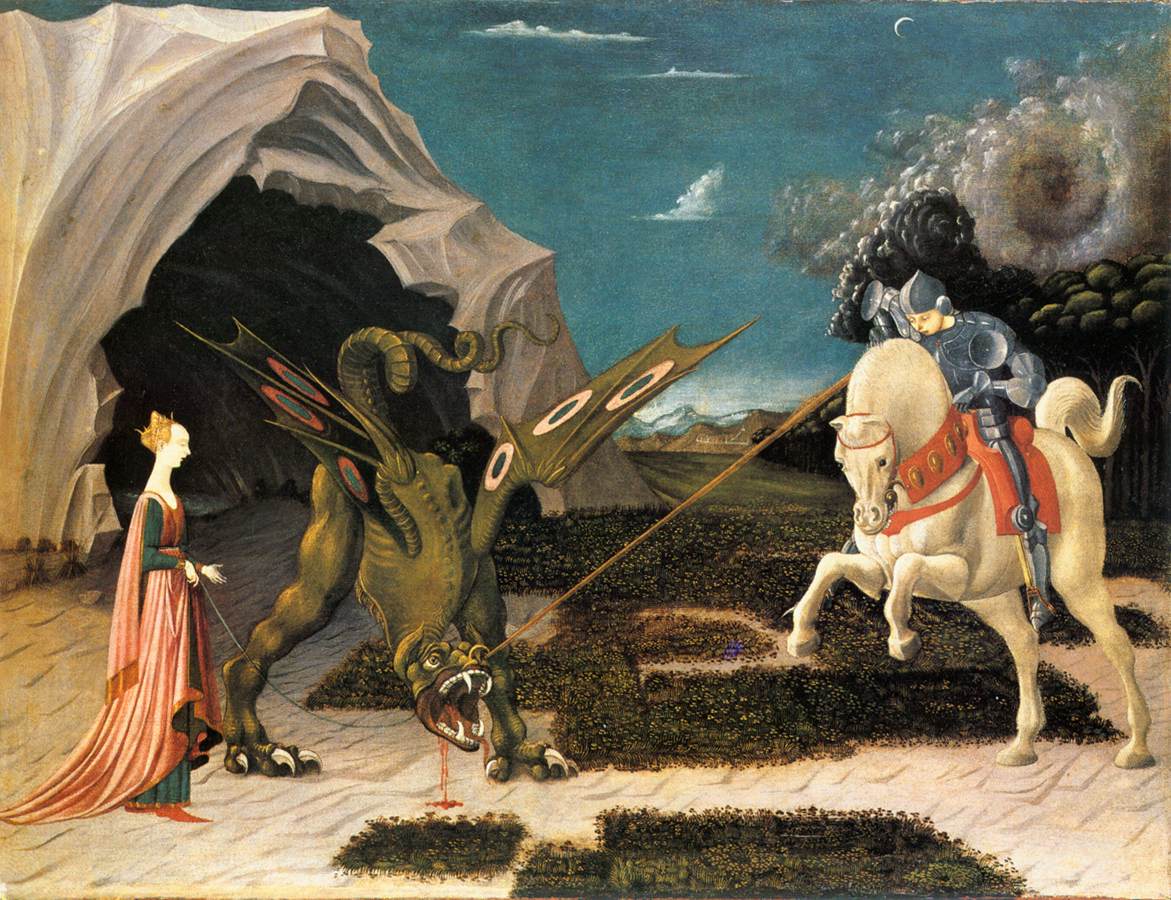
The princess holds the dragon on a leash. The monster is already under control, even as Saint George fights it: two moments of the legend coexist. Taking a dragon for a walk? Almost!
Compare the dragon’s silhouette with the opening of its cave: the shapes echo one another and heighten the strangeness of the scene.
The strips of vegetation lead the eye into the distance. Yet the stones on the ground follow another angle: this remains a distinctive construction of space.
On the right, follow the lance of Saint George, on his white horse, to the dragon’s head. Start again at the animal’s neck and follow the leash back to the princess’s hand on the left.
Now look at the dark opening of the cave behind the dragon. Compare its outline with the wings, then follow the strips of vegetation that recede behind the figures.
The lance shows the fight in progress. The leash shows the dragon already under control. Uccello brings those two moments into the same scene. On the ground, strips of vegetation lead you into the distance. Close by, the likeness between the wings and the cave ties the monster to its lair. You can find your way around this space and still feel that you are in a fairy tale.
The three panels show episodes from the Battle of San Romano, won by the Florentines in 1432. They are now in London, Florence and Paris. Compare what the lances do in each painting. The order in which the panels were originally displayed remains debated.
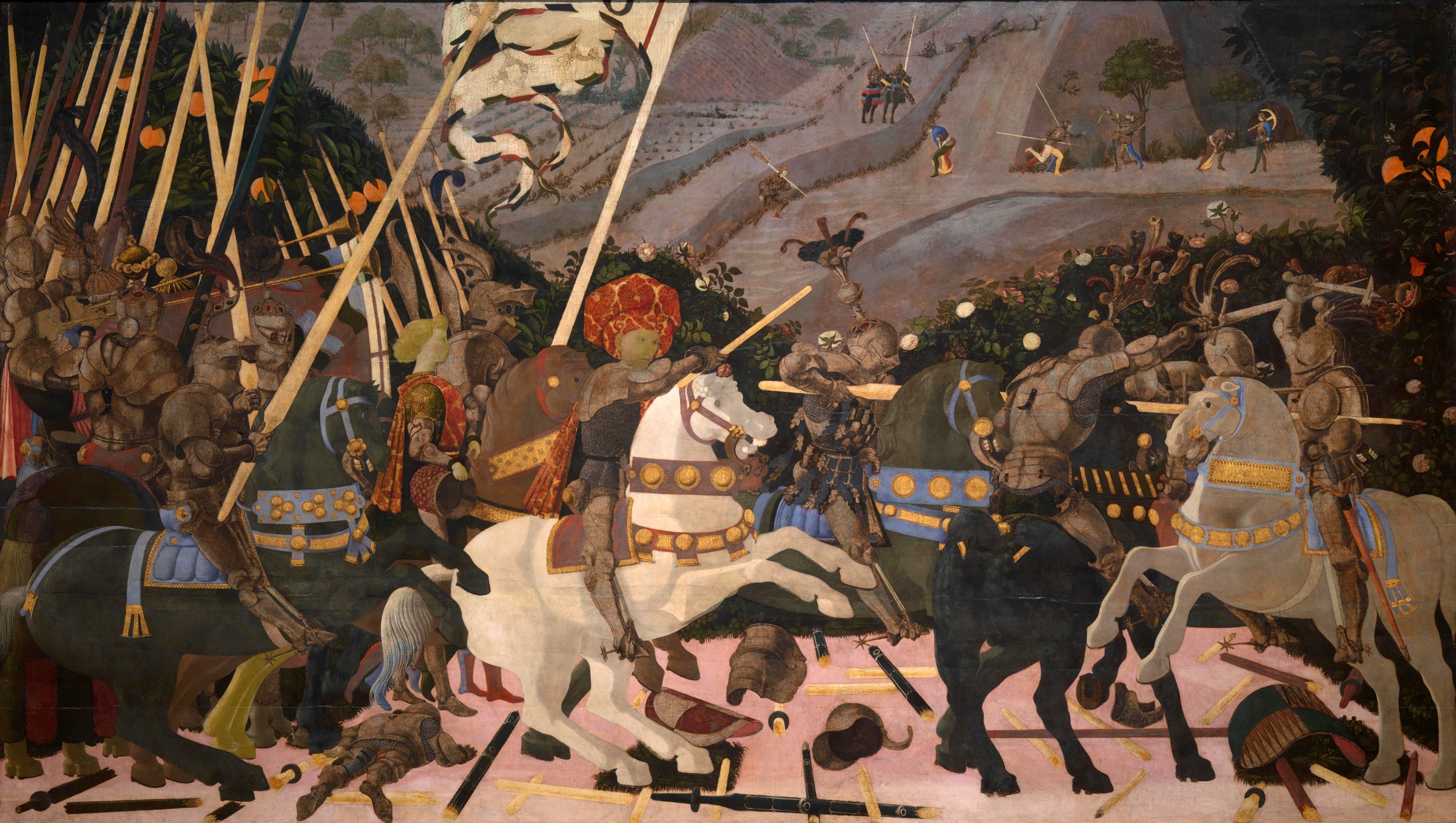
Paolo Uccello · c. 1438–1440 · NG583.
In London, look at the lances on the ground. Some point away from you, while others lie across them. Their loose grid makes the ground seem to stretch away beneath the horses.
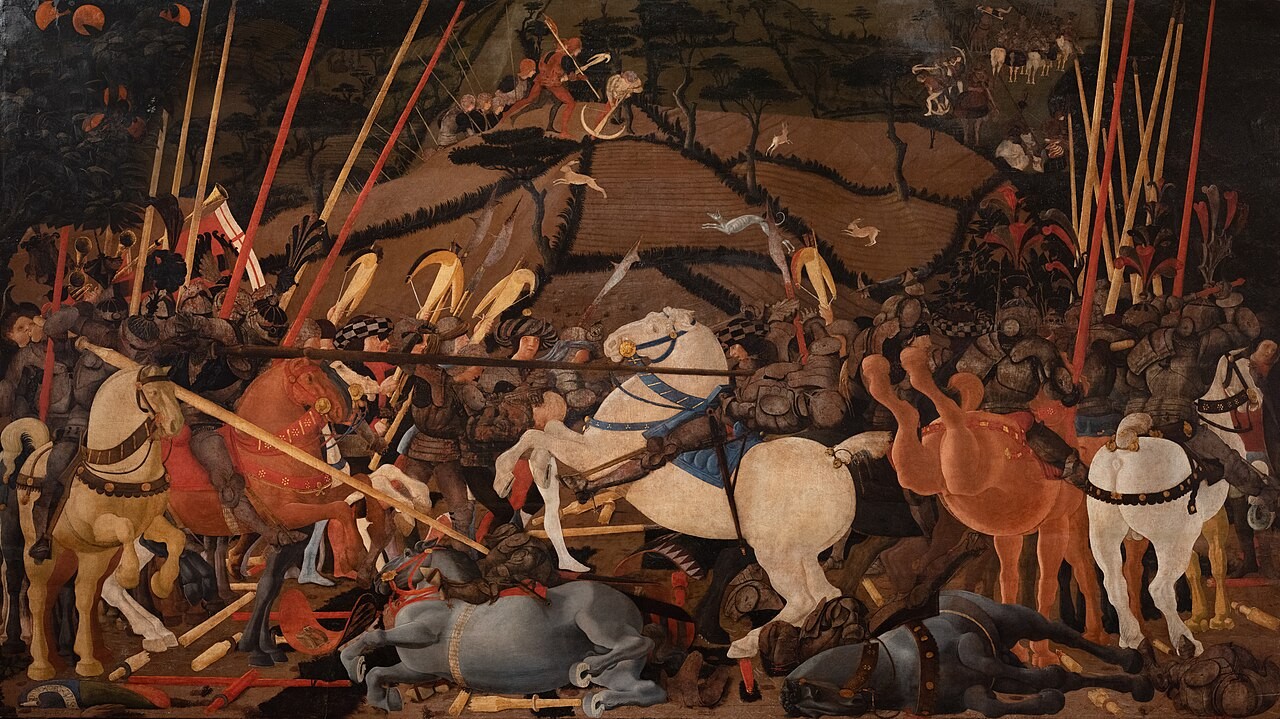
Paolo Uccello · c. 1435–1440
In Florence, follow the almost horizontal lance to the point of impact. It leads you to the moment when Niccolò da Tolentino unhorses Bernardino della Carda. Below, the horses and bodies on the ground show the battle from another angle.
Paolo Uccello · 15th century
In Paris, start with the upright lances near Micheletto. Follow those leaning to the right and find the horses shown at an angle. The lances lead your eye across the charge.
Find the panel where the lances mainly draw your eye to the ground, the one where they lead you to the impact, and the one where they give the charge its direction.
Connections to explore
Masaccio ↗ · Compare the architectural depth of the Trinity with Hawkwood’s painted pedestal.
Alberti ↗ · Explore the relationships between geometry, space and the way we look.
Donatello ↗ · Move from painting that imitates sculpture to space suggested in relief.
Uccello’s lost decoration in Padua also offers a connection with Mantegna, without making the latter his pupil.
Uccello makes perspective a field of invention. With Piero, see how an equally constructed space holds more restrained figures and a mysterious narrative.
In Hawkwood, you see the pedestal from below and the horse from the side. In another work, compare the viewpoint on the setting with the viewpoint on the figures.
At San Romano, follow the lances on the ground in London, then the raised lances in Paris. Look for another object that helps you read space or movement in the same way.
In Saint George, the outline of the wings recalls the cave opening. In another scene, see whether a figure picks up a shape from the landscape.
Uccello finds lines to follow in the very things he paints. In Hawkwood, seeing the pedestal from below makes the monument feel high above us. At San Romano, lances on the ground carry the eye into the distance, while raised lances give the charge its rhythm. In Saint George, the ground draws you into the picture and the leash brings you back to the dragon. You can follow the way space is built while discovering what makes the story so strange.
In another Uccello painting, pick a line and follow it with your eyes. Where does it take you? Which detail brings you back to the foreground?