Masaccio
1401–1428
In Masaccio’s paintings, bodies and settings give sacred stories an immediacy you can feel.
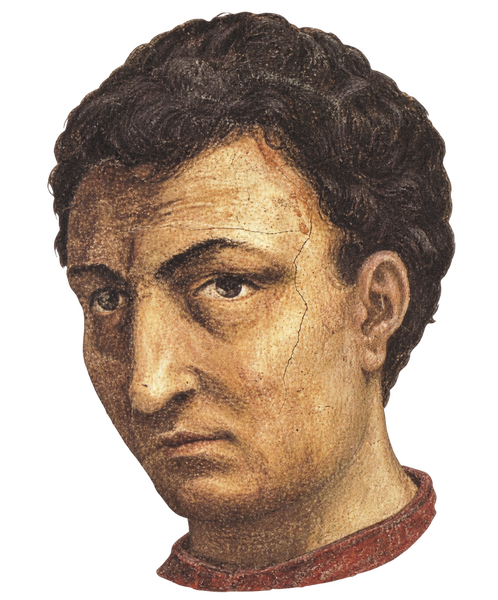
In a few words
Masaccio was born in 1401 in San Giovanni Valdarno, near Florence. His earliest known painting, the San Giovenale Triptych, is dated 1422. A few years later, he worked with Masolino on the frescoes in Florence’s Brancacci Chapel. He died very young in Rome around 1428. In just a few years, he became one of the painters who most profoundly changed Florentine painting at the start of the Renaissance.
The San Giovenale Triptych
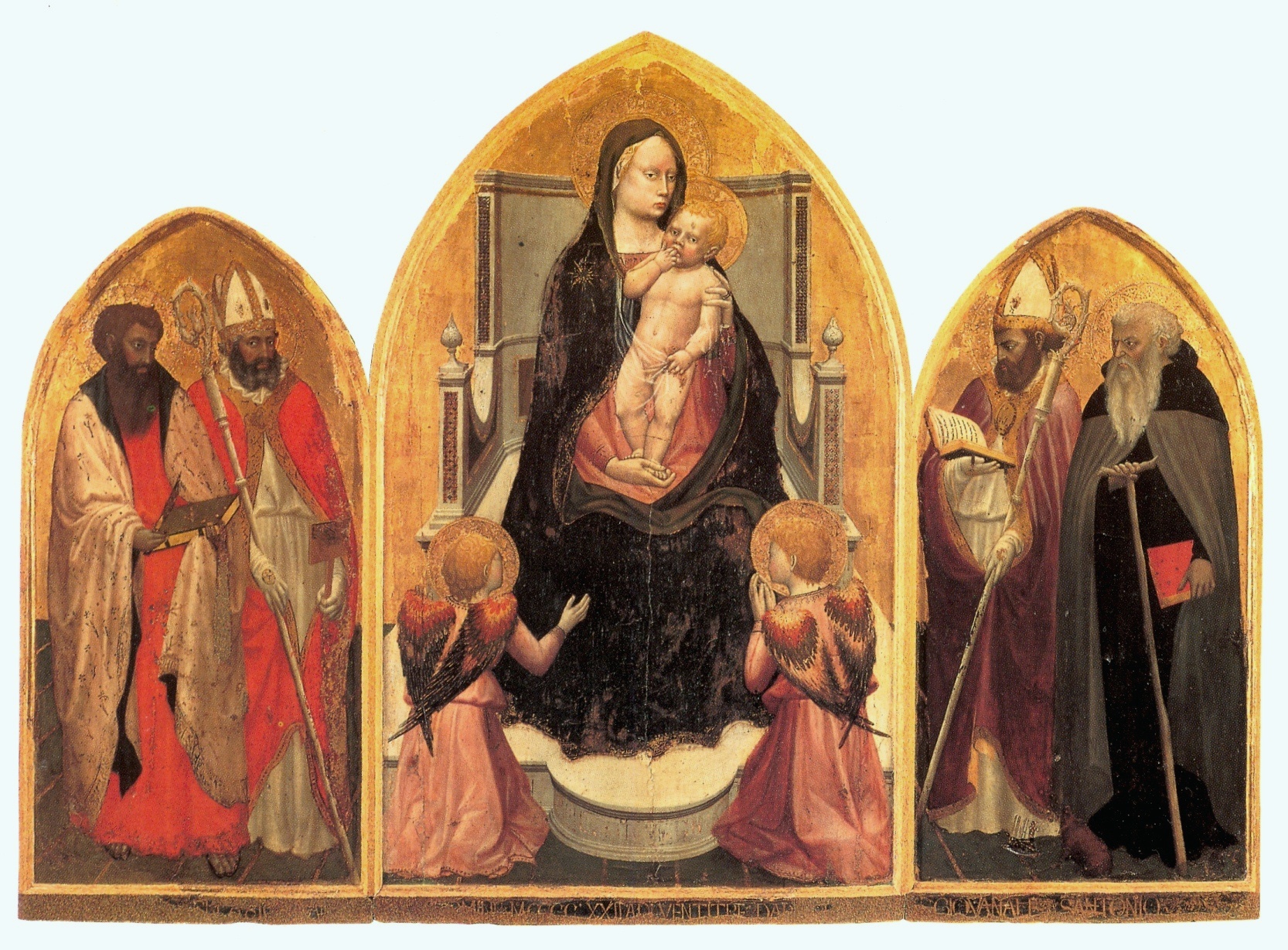 Follow the edge of the seat. It recedes into the picture, giving the throne a sense of depth.The Child stands on Mary’s lap. Notice how she supports him with one hand.The two angels kneel in front of the throne with their backs to us. Follow their gaze towards Mary and the Child.
One more detail
The Child holds a bunch of grapes, a reference to the wine used at Mass.
Look closely
At the centre, look at the legs of the Child standing on Mary’s lap, then at the hands supporting him. Below, two kneeling angels have their backs to you. Notice where they are in relation to the throne, then follow the lines of the green floor into the side panels.
Understanding
Three panels, one floor
The gold background belongs to the tradition of altarpieces. Beneath the figures, Masaccio paints a floor that runs from one panel to the next. The angels, closer to you than the throne, make the depth easy to sense. At the centre, the Child’s planted feet and Mary’s hands make the scene feel physically real. You can see how she bears his weight.
The Trinity
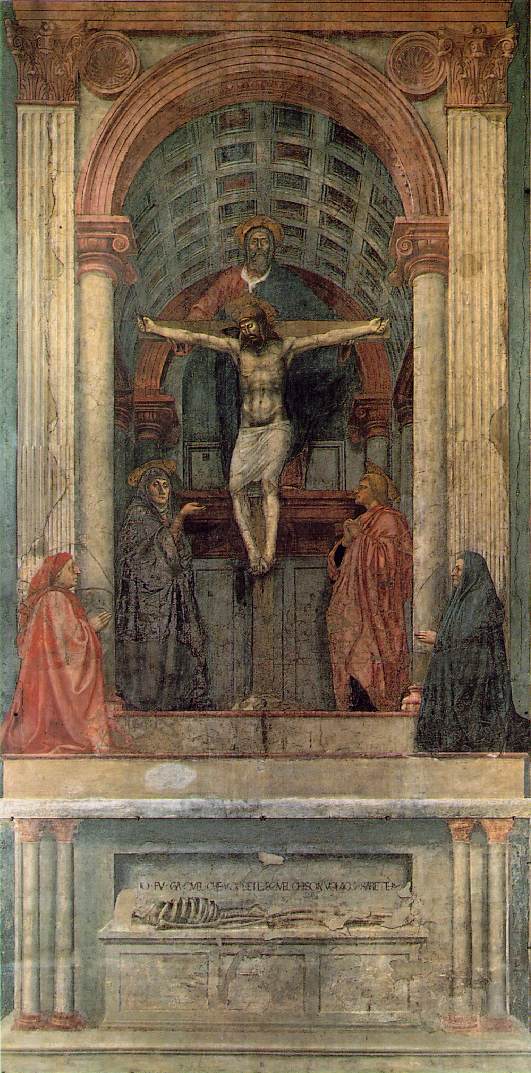
Follow the edges of the coffers towards the back. Extend the lines to find the vanishing point.
The horizontal line passes through that point. It marks the eye level from which the painted chapel takes on depth.
Find the two kneeling figures outside the columns. They are at the entrance to the sacred space.
Look at the tomb below the donors, then at the inscription above the body. It addresses the person standing in front of the fresco.
Look closely
Look up at the vault. Follow the edges of the coffers, the square recesses that appear to grow smaller towards the back. Under the vault, God the Father supports the cross, and the dove of the Holy Spirit is between him and Christ. To the left of the cross, Mary turns towards you and gestures to her son. On the right, Saint John stands with his hands joined.
Lower down, two donors kneel on either side of the opening. Look down again and you will see a skeleton lying beneath the scene.
Understanding
A painted chapel at eye level
The vault seems to recede behind the wall because its lines lead to a single point low in the picture. It feels as though you are looking into the chapel from the nave. The two donors occupy the threshold of this painted space, and Mary’s gesture invites you to look towards Christ. At the bottom, the inscription gives the skeleton a voice. It was once what you are, and you will become what it is. As your gaze moves from tomb to cross, the fresco brings its subject into contact with your own fate.
The Raising of the Son of Theophilus and Saint Peter Enthroned
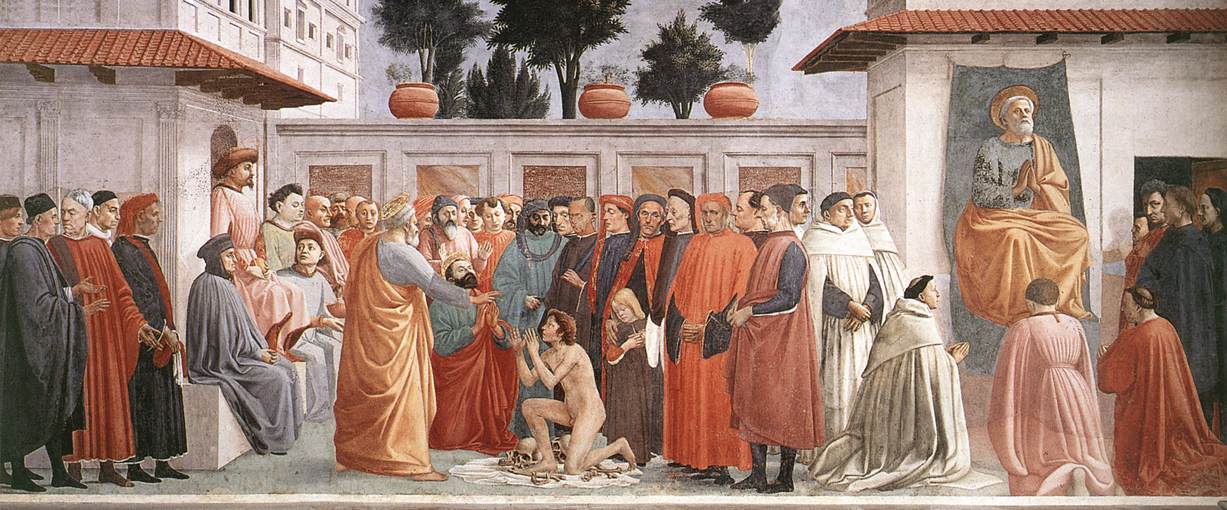 The boy kneeling before Saint Peter is at the heart of the miracle. The witnesses’ gestures and gazes draw your attention to him.Saint Peter appears a second time, seated and honoured by the faithful. The fresco brings together two successive moments in the story.
Look at the bones at the young man’s feet. They recall that, according to The Golden Legend, he had been dead for fourteen years.
Look closely
Find the kneeling young man in the left half. Saint Peter stands beside him and stretches out his hand. On the right, find Peter a second time. He sits on a raised seat, surrounded by people who turn towards him.
Understanding
One figure, two moments
The young man has just come back to life. Further along, Peter is already seated in the chair from which he addresses the faithful. The groups around him help you move from one episode to the next. A single space shows what happens first and what changes after the miracle. Masaccio began the fresco, and Filippino Lippi took it up again several decades later.
The Expulsion of Adam and Eve
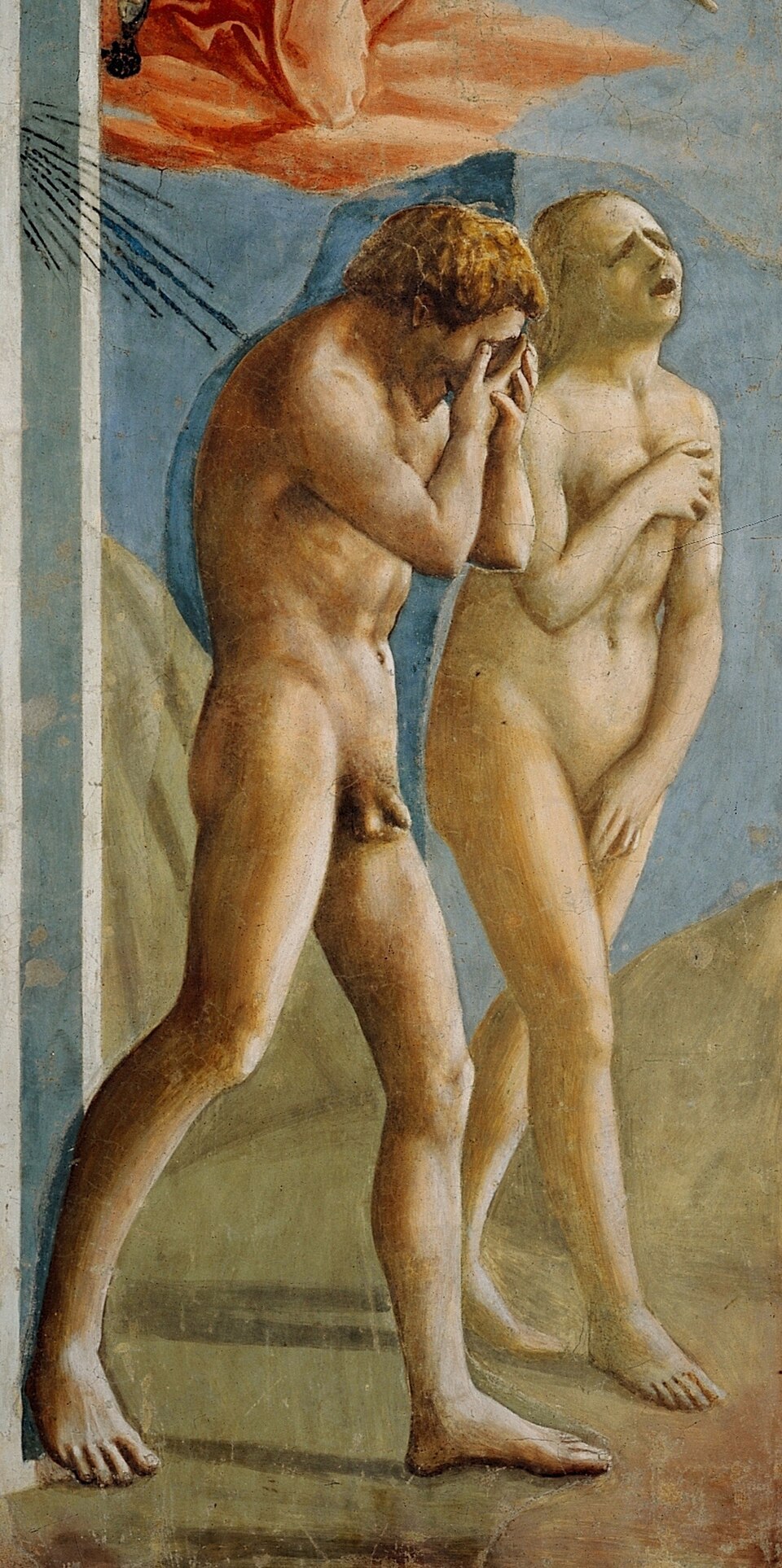 Adam buries his face in his hands. His body remains exposed, but he shields himself from our gaze.Eve covers her body but leaves her face uncovered. Her open mouth gives her grief the force of a cryTheir feet press against the ground and their bodies cast shadows. Their suffering feels physical and real.
Fig leaves were later painted over Adam and Eve’s nudity. They were removed during the restoration completed in 1990
Look closely
On the left, Adam lowers his head and covers his face with both hands. On the right, Eve covers her naked body. Her face is uncovered and her mouth is wide open. Now look at their feet and the shadows on the ground. Both are walking away from the gate beneath the angel driving them out.
Understanding
Two gestures express the same ordeal
Adam hides his face from you. Eve’s pain is visible even in the shape of her open mouth. Masaccio gives two forms to the same ordeal. The feet and shadows convey the effort of walking. Their departure from the garden is as clear in the way they move as in their expressions.

Explore further — Saint Peter Healing the Sick with His Shadow
Look closely
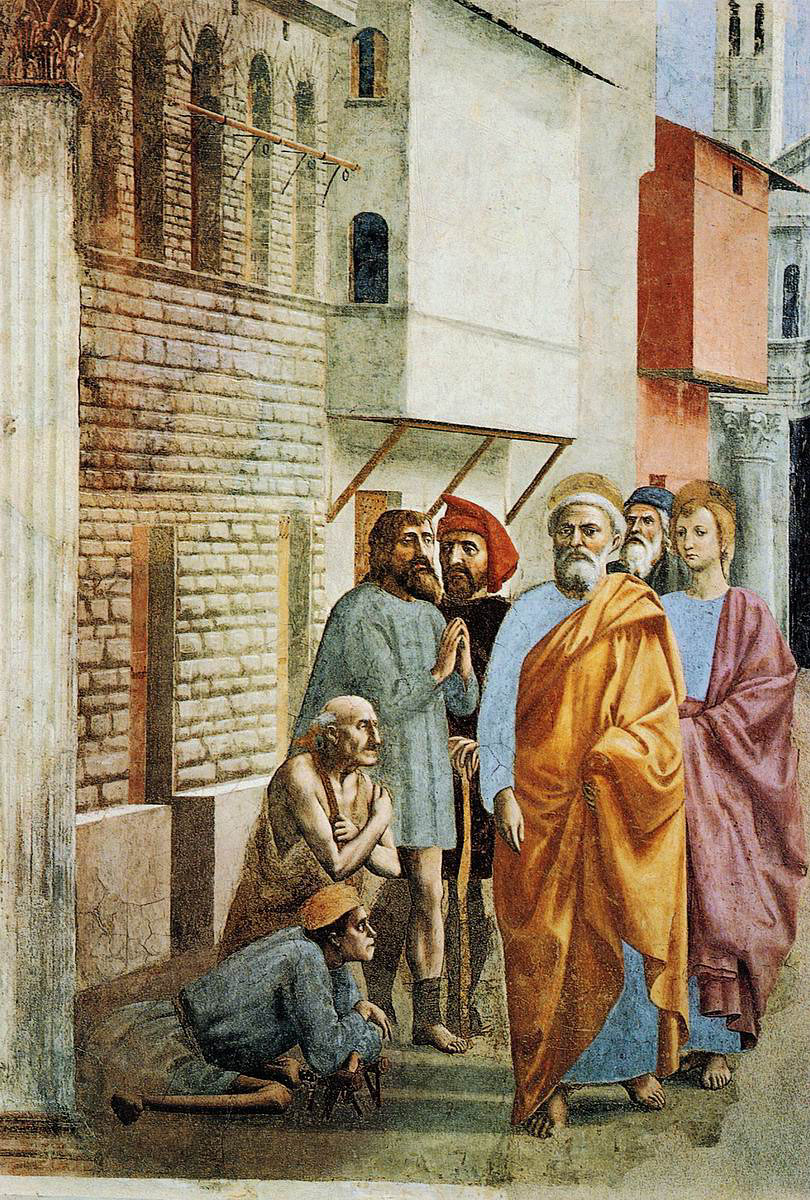
Find Saint Peter walking along the street, followed by Saint John. Look down at the men beside the buildings. One is still on the ground, another is getting up and a third is already standing. Then follow the walls and the lines of the street as they recede behind the figures.
Understanding
A healing you can follow from one figure to the next
The Acts of the Apostles describes people laying the sick in the streets in the hope that Peter’s shadow would fall on them as he passed. Masaccio makes the healing visible through a sequence of postures. One man is down, another is getting up and another is standing. Peter walks on, and the street gives the sequence a direction. You can see the miracle in what the bodies are able to do again.
How to recognise Masaccio?
Hands support weight and feet find firm ground
In the San Giovenale Triptych, look at Mary’s hands and the Child’s feet. In another painting, ask yourself who is supporting whom, and where you can see that weight.
Architecture gives you a viewpoint
In the Holy Trinity, the recesses in the ceiling grow smaller towards the back, and you see the vault from below. In another work, look for a painted floor or ceiling that gives you a sense of where you are looking from.
Shadows anchor bodies to the ground
In the Expulsion, look down at Adam and Eve’s feet. The shadows help you see where they step and which way they are moving.
A single gesture can convey an emotion
In the Expulsion, compare Adam’s hands, which hide his face, with Eve’s, which cover her body. In another painting, look for an equally simple gesture that lets you see what a figure feels.
Key takeaways
Masaccio was among the painters who gave Renaissance figures weight and a place in a space the viewer can make sense of. In the San Giovenale Triptych, Mary’s hands support the Child on a throne that has depth. In the Holy Trinity, a painted vault makes you aware of where you are standing in front of the wall.
In the Brancacci Chapel, this way of painting helps tell the story. The son of Theophilus comes back to life before Peter reappears, seated in his chair. Adam and Eve stride out of the garden. In the street where Peter passes, the sick rise to their feet. In another painting by Masaccio, start with the feet or hands. What can they tell you before you even know who the figures are?
Poursuivre la découverte
After looking at the vault in the *Holy Trinity*, turn to the *Monument to John Hawkwood*. You see the sarcophagus from below and the rider from a different viewpoint. See if you can spot the shift as your eye moves from one to the other.
After the *Holy Trinity*, find another coffered vault in the *Montefeltro Altarpiece*. Follow it to the hanging egg, then look down towards Mary. You can see how Piero, too, uses architecture to lead your eye.