Piero della Francesca
Vers 1415–1420 — 1492 · Italie centrale
A major figure of the Italian Renaissance, Piero della Francesca uses perspective to tell a story.
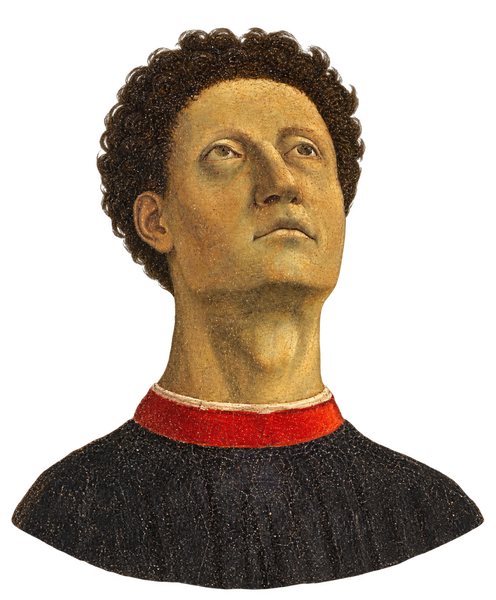
In a few words
Born around 1415–20 in Borgo Sansepolcro, Tuscany, Piero worked in Florence with Domenico Veneziano in 1439 and later spent time at the Montefeltro court in Urbino. He died in 1492. A few decades after Alberti set out the principles of perspective, Piero wrote the first drawing manual devoted to perspective for painters, De prospectiva pingendi. He used diagrams and demonstrations to explain how to depict forms in depth on a flat surface. The treatise circulated in manuscript form among artists’ workshops.
As you look at his paintings, ask yourself how Piero guides what you see first and what you discover next.
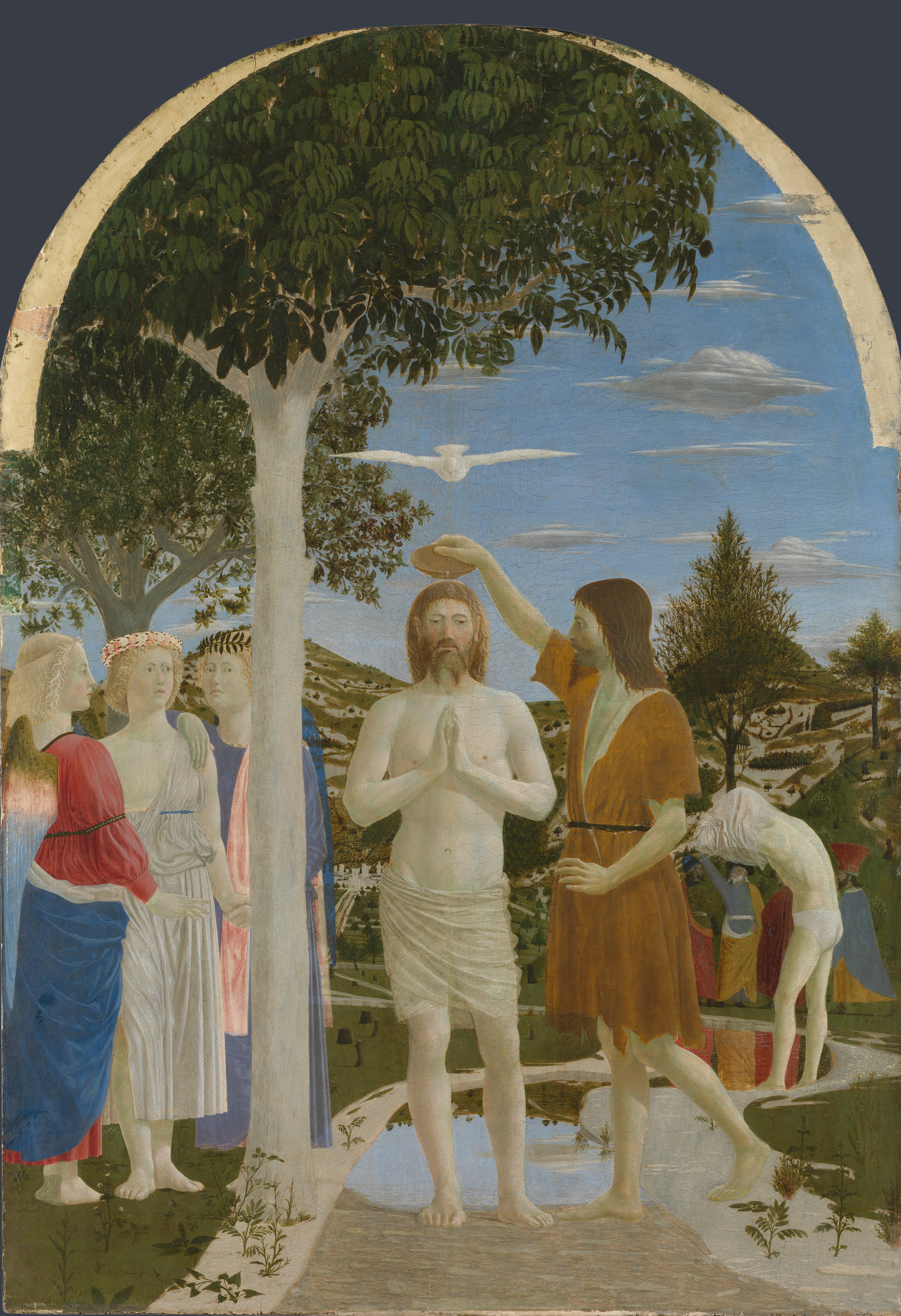
On the banks of the Jordan, an almost imperceptible gesture is enough to hold your gaze.
Look closely
Find Christ’s clasped hands at the centre. Look up to the bowl John the Baptist tips over his head, then to the white dove with its wings spread. On the left, the pale tree trunk echoes the upright line of Christ’s body.
Now look behind John the Baptist. A man bends over to take off his tunic. Follow the stream towards the hills, where the figures grow smaller.
Understanding
A precise gesture in a familiar landscape
By lining up the dove, the sign of the Holy Spirit, with the bowl and Christ at prayer, Piero makes the connection between a human gesture and the revelation that gives it meaning easy to see. The echo between tree and body carries this balance into the landscape. The man taking off his tunic, presumably to be baptised in turn, and the winding stream add depth to the encounter. The hills recall the countryside around Sansepolcro, where the panel was made for the church of San Giovanni Battista in Val d’Afra. The biblical Jordan takes on features the painting’s first viewers would have recognised.

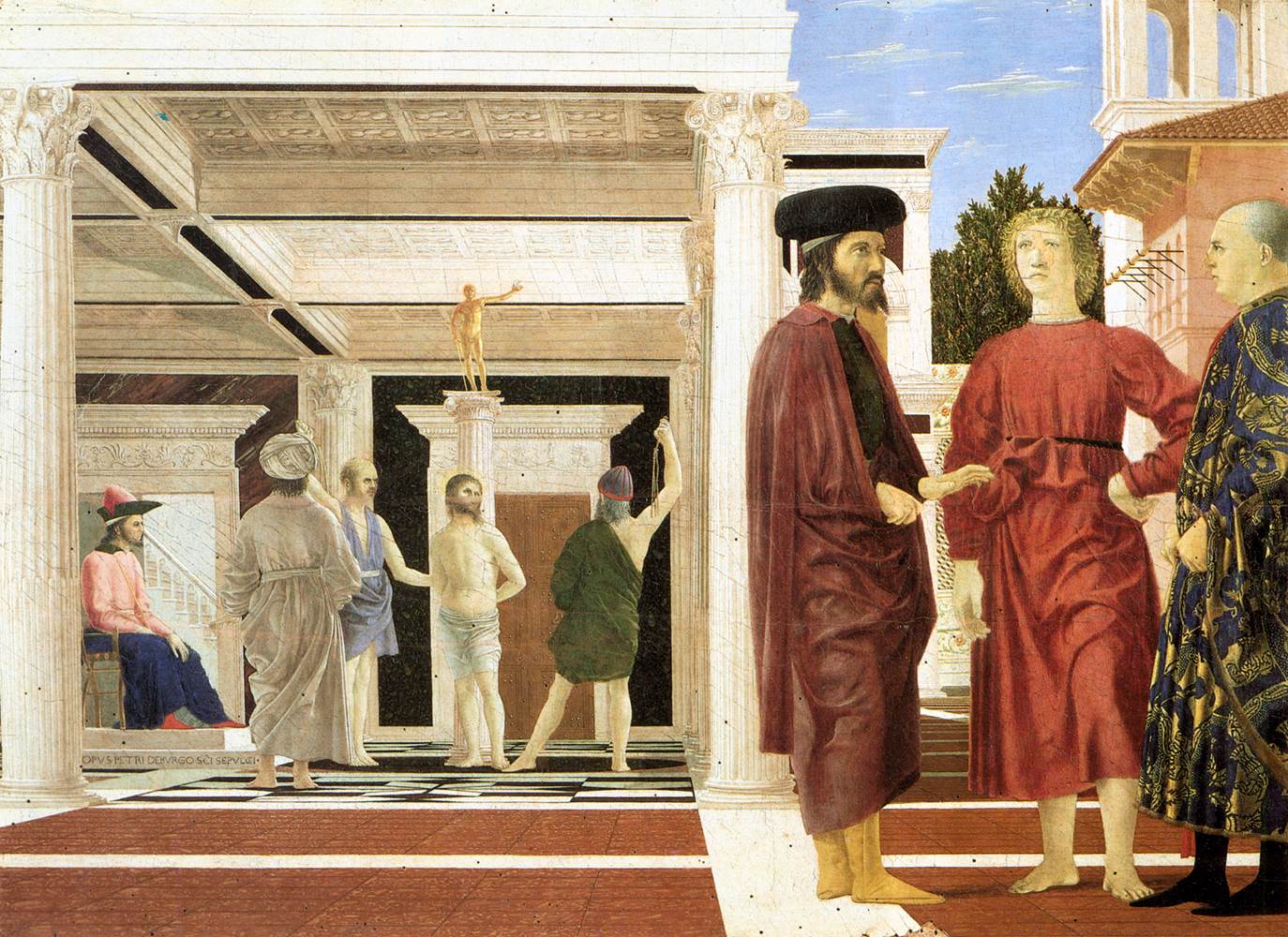
Christ is bound to a column in the distance. Why do three men fill the foreground?
Look closely
Under the portico on the left, find the bare-chested Christ tied to a column. At the far left, Pontius Pilate sits on a raised seat. Outside on the right, find the barefoot, fair-haired young man between a bearded man and a man in brocade. None of the three turns his face towards the punishment.
Follow one of the paving lines as it recedes under the portico. It takes your eye from the large foreground figures to the smaller bodies around Christ.
Understanding
Two scenes in a shared space
Perspective lets us gauge the distance between the two groups. It makes the decision to place the incident that gives the painting its title in the background all the more striking. The size and proximity of the three men on the right draw our attention first, then the paving lines lead the eye back to the punishment. Piero prompts us to look for a connection that gestures and glances leave open. The identities of the three men, the patron and the work’s original destination remain uncertain.
Four soldiers sleep. Above them, Christ looks straight at you.
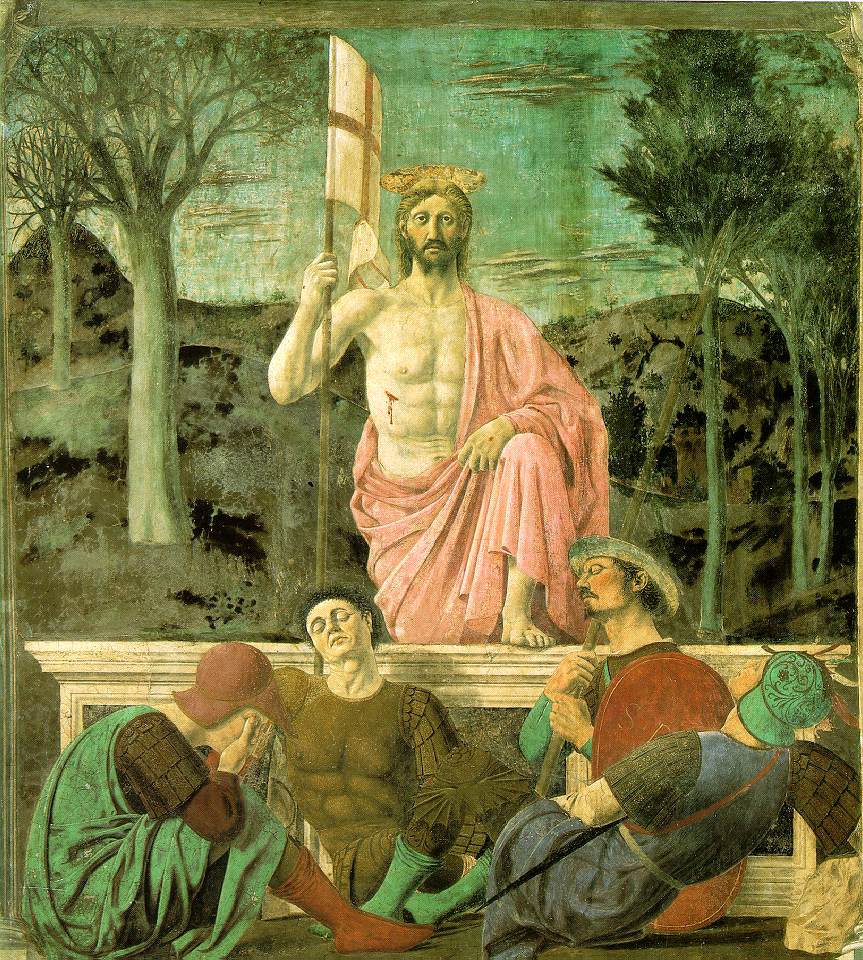
Look closely
Look up from the foot planted on the rim of the tomb to Christ’s eyes. Compare his upright body with the sloping shoulders and tilted heads of the four guards. The stone rim divides the two groups. Higher up, on either side of Christ, notice the bare trees on the left and the leafy ones on the right.
Understanding
The one gaze that meets yours
The planted foot gives the risen body a tangible weight. The guards’ postures make Christ’s upright stance more striking, and his direct gaze draws us into an event the figures either face away from or sleep through. The passage from bare branches to foliage can be read as an echo of the return to life. In Sansepolcro the image also has a civic dimension. The risen Christ already appeared on the town seal, and the painting is associated with the palace of the town magistrates.
The coffers recede into the vault and the egg seems to hover over Mary. How far back is it?
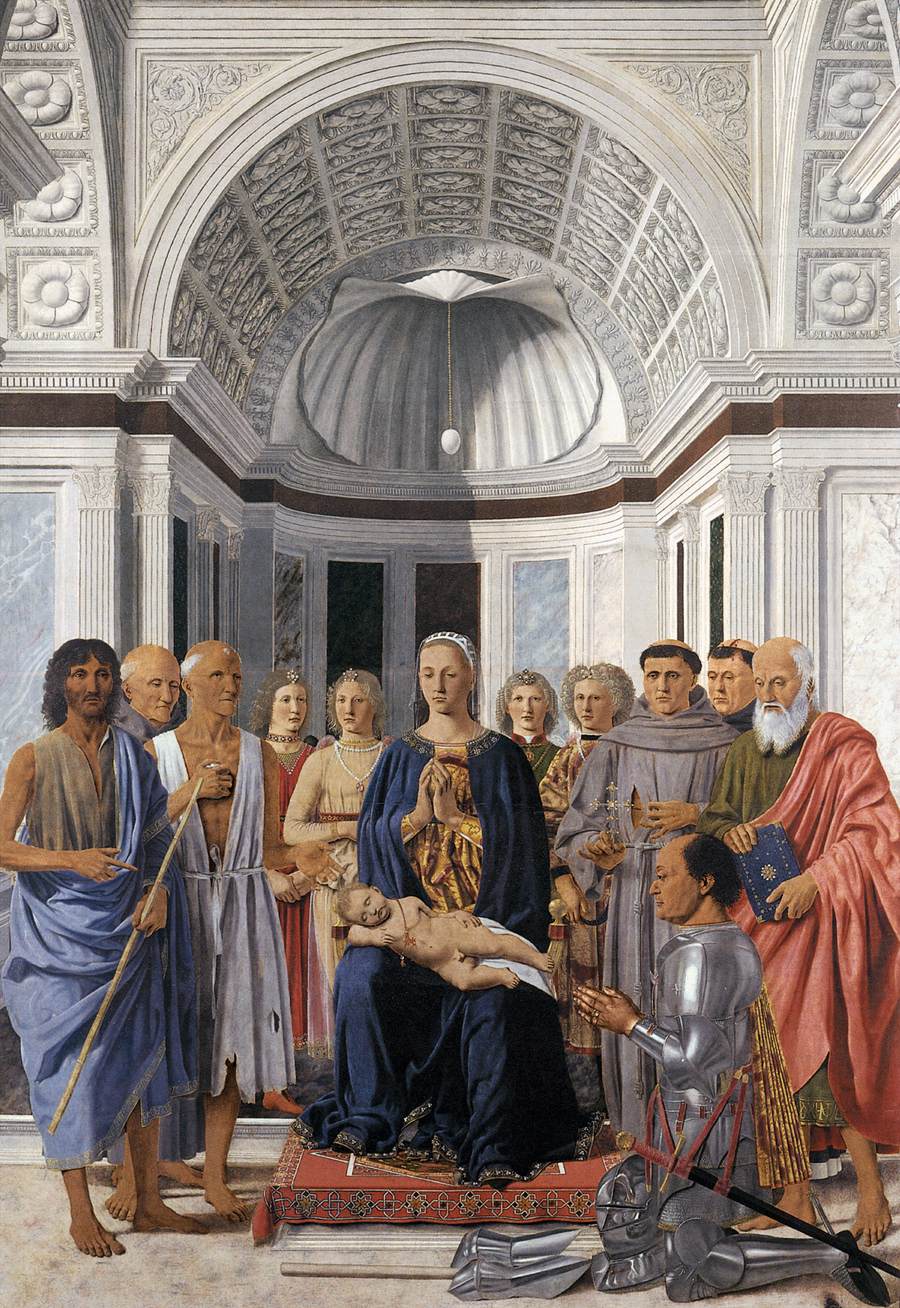
Look closely
Start with the shell at the back of the vault. Follow the slender chain down to the egg, then lower your gaze to Mary and the sleeping Child on her lap. Compare the egg’s position in the architecture with that of the figures, who stand in front of the apse.
At the lower right, Federico da Montefeltro kneels in profile with his hands joined. Find the bright reflection on the shoulder of his armour, then look for the small glints of light on the angels’ ornaments.
Understanding
The same light falls on saints and duke
This type of altarpiece, known as a sacra conversazione, brings the Virgin, Child and saints together in a shared space. Piero’s architecture gives that space depth, and the alignment of the egg with Mary draws the eye back to the group. Federico takes his place in the foreground. The reflections on his armour link the patron to the sacred figures, while his kneeling posture and clasped hands show him at prayer. The painting brings together an act of devotion and the duke’s rank, visible even in the metal of his armour.
Two panels, two profiles and a landscape that runs from one portrait to the other.
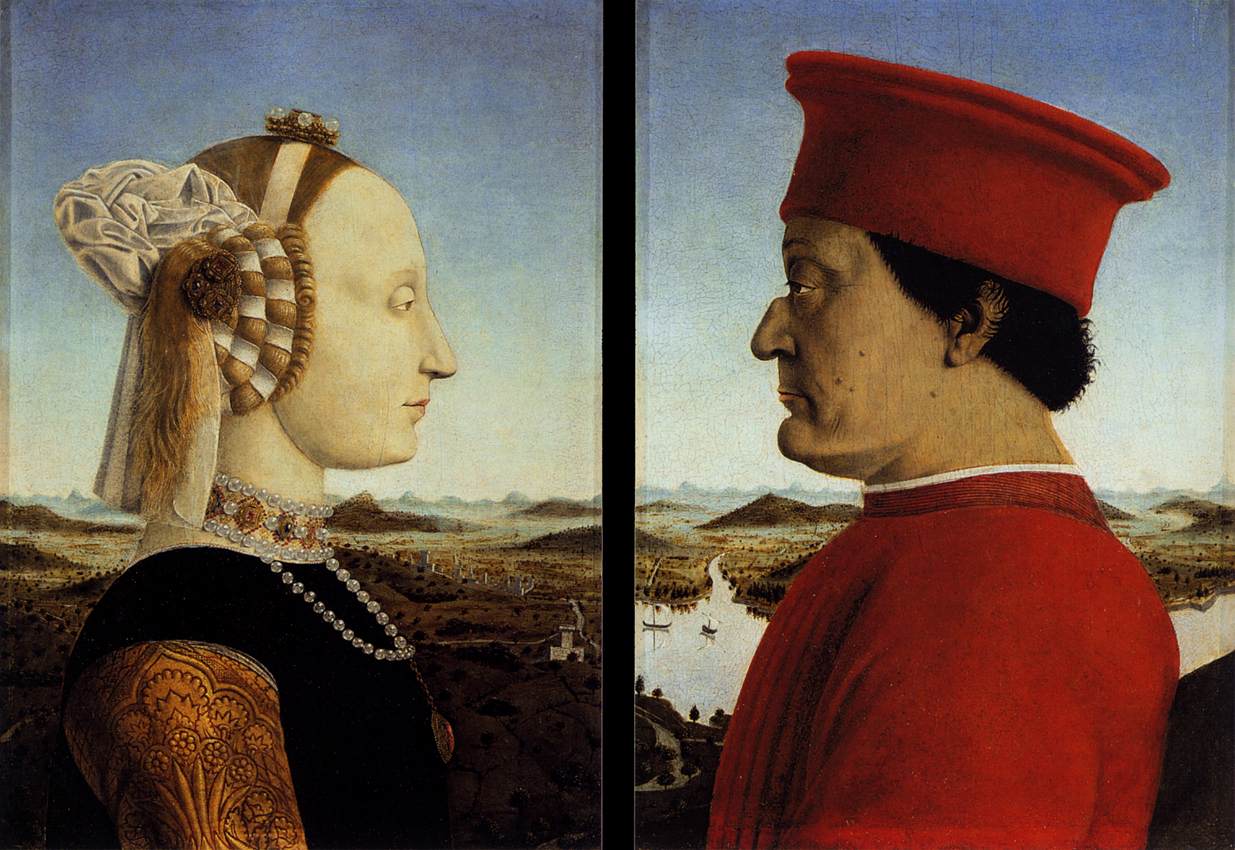
Look closely
On the left, notice Battista’s high forehead, pearls and braided hair. On the right, you can recognise Federico by his red cap and the outline of his nose. Compare the two profiles against the sky. Then lower your eyes to the water and hills behind them. At what height does the landscape pick up on the other panel?
Understanding
Two court portraits in one landscape
The profile follows a convention inspired by ancient coins. It makes each silhouette immediately legible and allows Piero to bring out the distinctive features of each sitter. The continuous landscape gives the two portraits a shared setting. The Uffizi identify it as an evocation of the lands governed by the Montefeltro. The setting gives the couple both an individual and a dynastic presence. Battista died in 1472, before the date usually assigned to the diptych. Her pallor has sometimes been linked to her death, though it also reflects contemporary conventions of beauty.
How to recognise Piero della Francesca?
Light brings out the forms
Notice how light falls on skin, fabric and landscape. In the Baptism, Christ’s pale skin echoes the light colour of the tree trunk. Behind them, the hills remain clear even far in the distance.
The figures feel firmly grounded
Look at how the bodies hold themselves. In the Resurrection, Christ plants one foot on the rim of the tomb and stands upright above the slumped guards. His body looks as solid as the stone beneath his foot.
Space is part of the story
Find a line on the ground and follow it. In the Flagellation, the joins between the paving stones lead your eye from the three men in the foreground to Christ under the portico further back. The floor helps you discover what is happening.
Emotion is restrained
Look at the hands and faces. In the Baptism, John the Baptist raises one hand to pour the water, while Christ keeps his hands joined and his face calm. In Piero’s paintings, a small gesture can be enough to tell you that this is the decisive moment.
Key takeaways
Piero holds a central place in Renaissance painting because he made perspective both a skill artists could pass on and a way to guide our reading of a scene. In the Baptism, the figures behind John the Baptist grow smaller, giving depth to a familiar landscape. In the Flagellation, that depth makes us look past the three men in the foreground to find the punishment. The Resurrection does something different: we see the guards from a low viewpoint, while Christ seems to meet us at eye level.
In the Montefeltro Altarpiece, the architecture brings the kneeling duke and the saints into the same space. In the Montefeltro diptych, a continuous landscape links two panels and places the sitters within the territory they rule. In another painting by Piero, notice which figure catches your eye first, then follow a line to the detail it helps you discover.
Pour aller plus loin
Franck Mercier · France Culture · L’Art est la matière. Audio in French: another perspective on Piero’s paintings.