From the Flagellation to the Ecce Homo
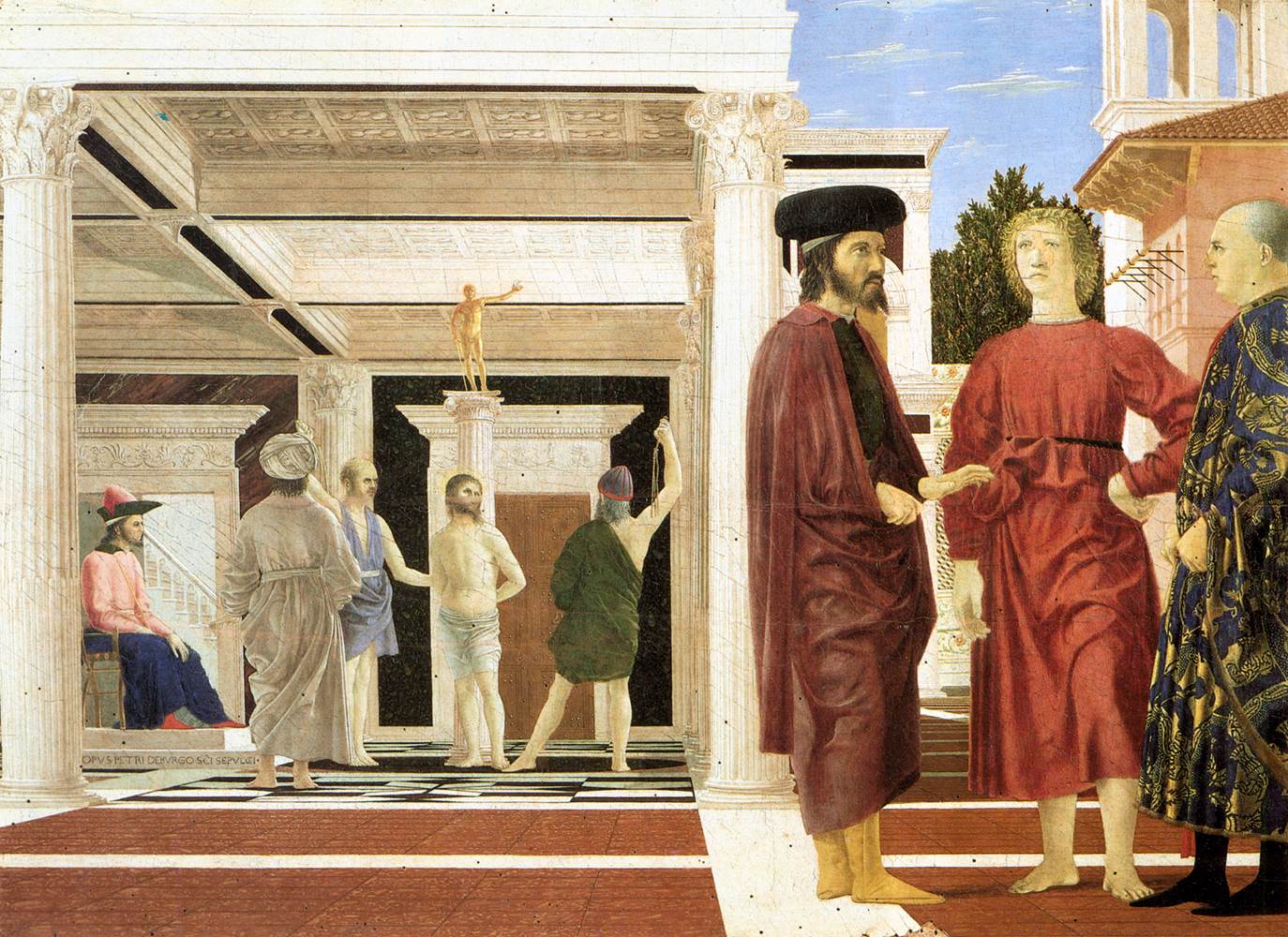
Why does the seated man at the far left matter? He represents Pontius Pilate, the Roman governor before whom Jesus is brought. The accusation that Jesus claims to be ‘King of the Jews’ gives the questioning a political dimension. In John’s Gospel, the question of kingship leads Pilate to ask Jesus what truth is.
The four Gospels place the punishment at different points. In Matthew and Mark, Pilate has Jesus scourged before handing him over to be crucified. Luke reports that Pilate proposes to punish and release Jesus, and leaves the punishment itself undescribed. In John, the scourging takes place while Pilate is still seeking his release. The soldiers mock his kingship with a crown of thorns and a purple robe. Pilate then presents him to the crowd, saying ‘Behold the man’, or Ecce Homo in Latin. The phrase gave its name to another subject in Christian painting: Christ being presented to the crowd after his punishment.
Look back at the barefoot, fair-haired young man in the middle of the group. One interpretation linked to Urbino identifies him as Oddantonio da Montefeltro, who was murdered in 1444. Other interpretations connect the painting with the fall of Constantinople in 1453 and read the punishment as an image of the suffering of Eastern Christendom. These readings explain the unusual prominence of the three men in different ways. Their identities remain open to debate.
Matthieu 27 · Marc 15 · Luc 23 · Jean 18 et Jean 19 ·