Léonard de Vinci
1452–1519
A turning face, a hesitant hand, an emotion spreading through a group: Leonardo observes the visible world to suggest an inner life.
Observing the visible world to convey an inner life
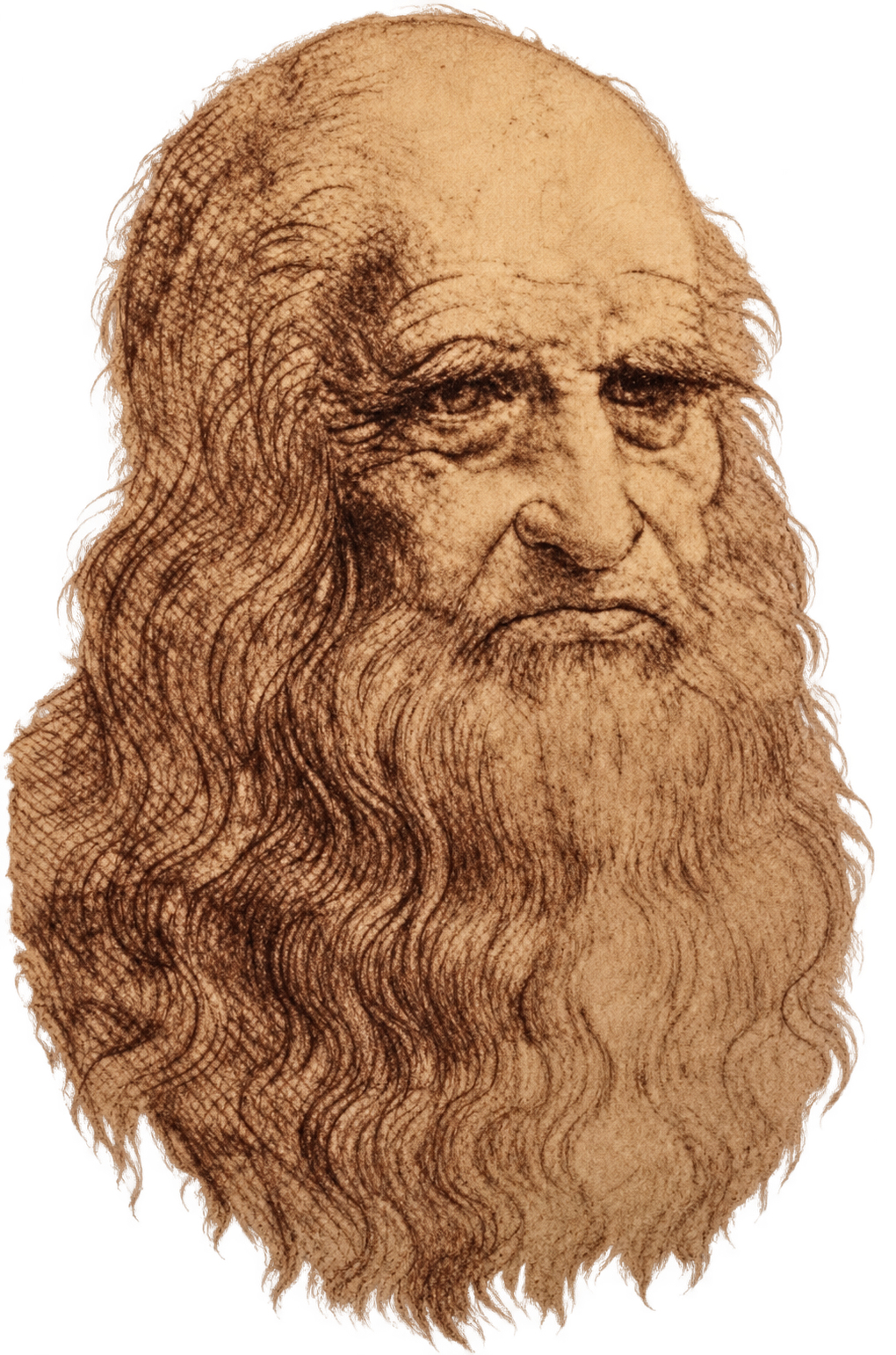
In a few words
Born near Vinci in 1452, Leonardo trained in Verrocchio’s workshop in Florence. He worked particularly in Florence and Milan, and spent his final years in France, where he died in 1519.
For him, painting began with observation: light, plants, bodies and movement were part of the same inquiry. Drawings and studies supported a painting practice attentive to relationships between living beings. He sought to convey a presence, a reaction or a thought that cannot be seen directly.
The Annunciation
Web Gallery of Art · Domaine public — PD-Art / Public Domain Mark 1.0
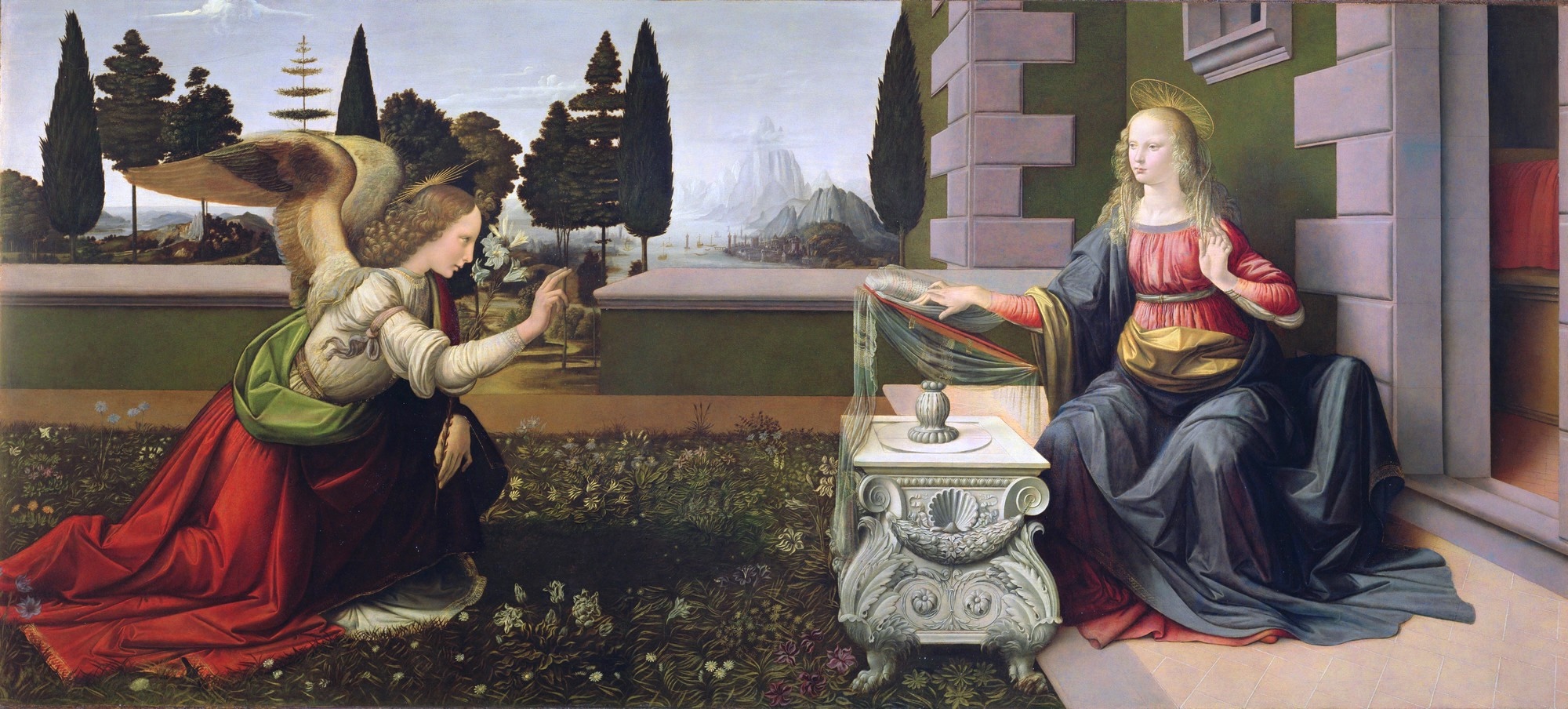
The lily: a sign of purity. This flower traditionally accompanies the announcement to Mary and evokes her virginity.
An interrupted reading. One hand remains on the pages; the other rises towards Gabriel. These gestures convey the shift from reading to encounter.
A landscape receding into haze. The mountains become paler and their outlines less distinct. Compare them with the sharply defined foreground plants: differences in clarity also create depth.
An angel given bodily presence. His shadow places him within the garden: this heavenly apparition seems to share Mary’s light and space.
Look closely
Begin with the hands: Gabriel greets Mary. Her right hand remains on the open book, while her left hand rises in response: Leonardo makes the interruption of her reading visible.
Look at the flowers and blades of grass in the foreground: their shapes are clearly defined. Then look at the mountains in the centre of the landscape: the farther away they are, the paler they become, and their outlines fade into the haze. This contrast creates a sense of depth.
Understanding
Gabriel tells Mary that she will give birth to Jesus. Leonardo places this religious subject in a garden where light gives the figures a physical presence. The sacred event enters an observable world.
This early work dates from his time in Verrocchio’s circle. It reveals an inquiry that runs through his painting: understanding how nature appears to our eyes in order to paint it.

The Virgin of the Rocks — Louvre Version
Reproduction via GalleriX — auteur photographique non précisé · Domaine public — PD-Art / Public Domain Mark 1.0
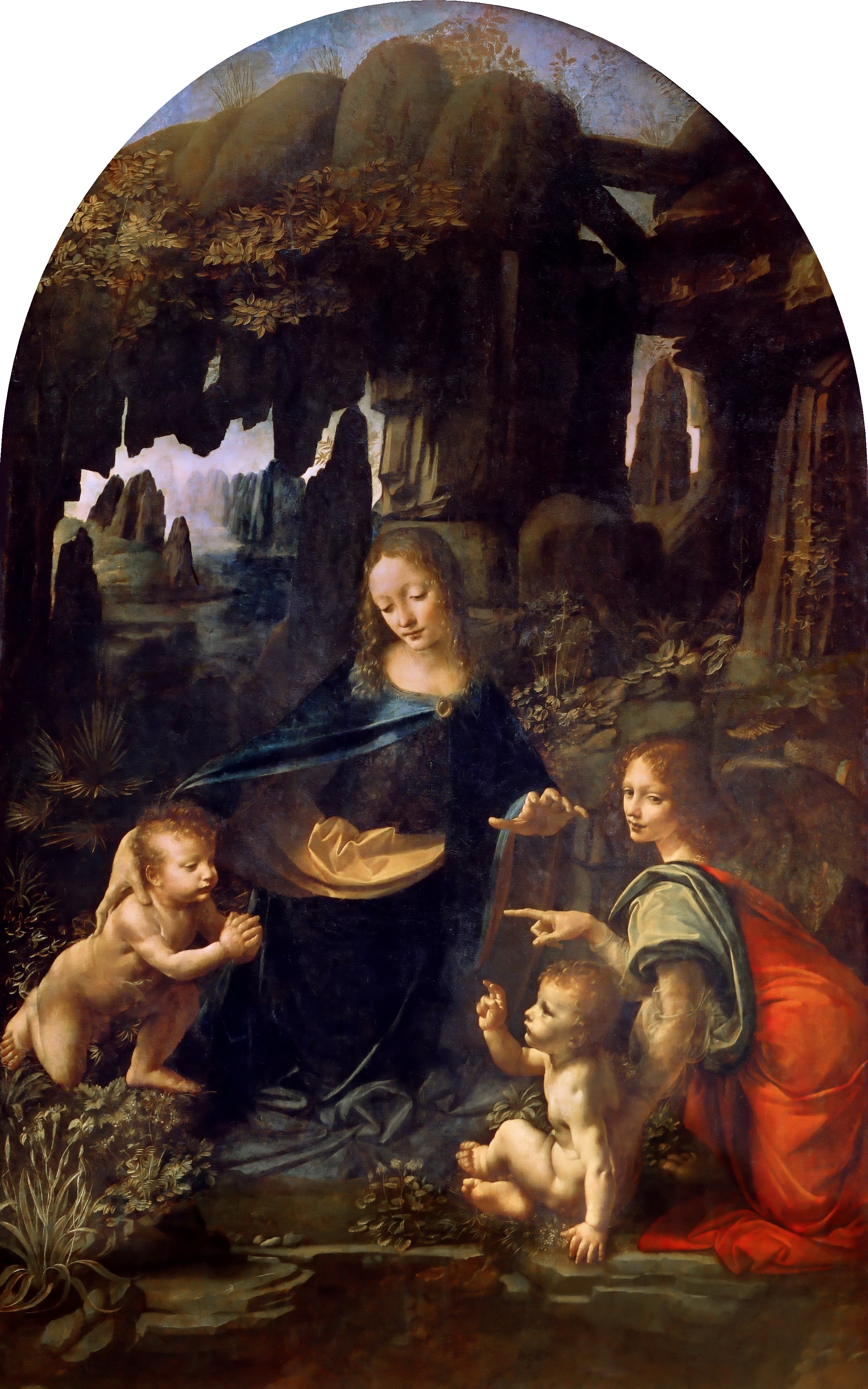
John the Baptist is on the left, kneeling with his hands joined. Jesus is on the right, beside the angel: he raises his hand to bless John. Distinguishing them helps us understand their gestures.
Mary’s head rises above the group. The figures spread out towards the bottom, forming a pyramid. This structure brings the four figures together and gives stability to their varied gestures.
Mary draws John close and extends her hand above Jesus. Jesus responds to John’s joined hands with a blessing. Their gestures reveal relationships without anyone speaking.
The angel looks towards us, but points to John the Baptist. The gaze catches our attention; the hand directs it towards the child. We are invited to follow the gesture and take part in reading the painting.
Look closely
In this Louvre version, follow the hands: Mary shelters the young John the Baptist with one hand and holds the other above Jesus. Jesus blesses John; the angel points towards John and looks out at us.
The figures are not simply placed side by side: they form a network of relationships. Notice how they emerge from the shadows of the grotto, then find the openings onto the landscape.
Understanding
The painting is connected with a commission made in 1483 for a chapel in Milan. The Virgin, Jesus, the young John the Baptist and an angel meet in a rocky setting. The angel’s exact identity and the interpretation of the scene have prompted several hypotheses.
We need not resolve every question to look closely: gestures and light unite the group and give the religious subject a tangible presence. A second, different version is in London.
The Last Supper
Reproduction numérique — version FXD mise en ligne par Pixel8tor · CC BY-SA 4.0 — reproduction numérique ; œuvre dans le domaine public
Follow Christ’s silhouette: his head rises above a body that broadens towards the hands. This triangular shape creates a sense of stability. Compare it with the apostles’ leaning bodies and animated gestures.
The lines of the room seem to recede into the wall. Extending them reveals that they converge towards Christ: perspective creates depth and draws our attention to him.
The apostles react in groups of three. Within each group, glances and hands carry the emotion. Around the relatively still Christ, the announcement of betrayal triggers a succession of responses.
Look closely
First notice Christ’s relative stillness at the centre. On either side, the apostles lean together, turn, question and spread their hands. Compare their reactions before trying to identify their names.
Then follow the lines of the walls and ceiling towards the centre. The space remains ordered, while the gestures convey the disturbance spreading along the table.
Understanding
During the last meal, Jesus announces that one of his companions will betray him. Leonardo makes these words perceptible through the apostles’ reactions: the event becomes a study of emotion.
The painting occupies a wall of the refectory at Santa Maria delle Grazie in Milan. Leonardo worked on a dry surface, using a method that allowed revisions, rather than painting on fresh plaster in the traditional fresco technique.
Lady with an Ermine
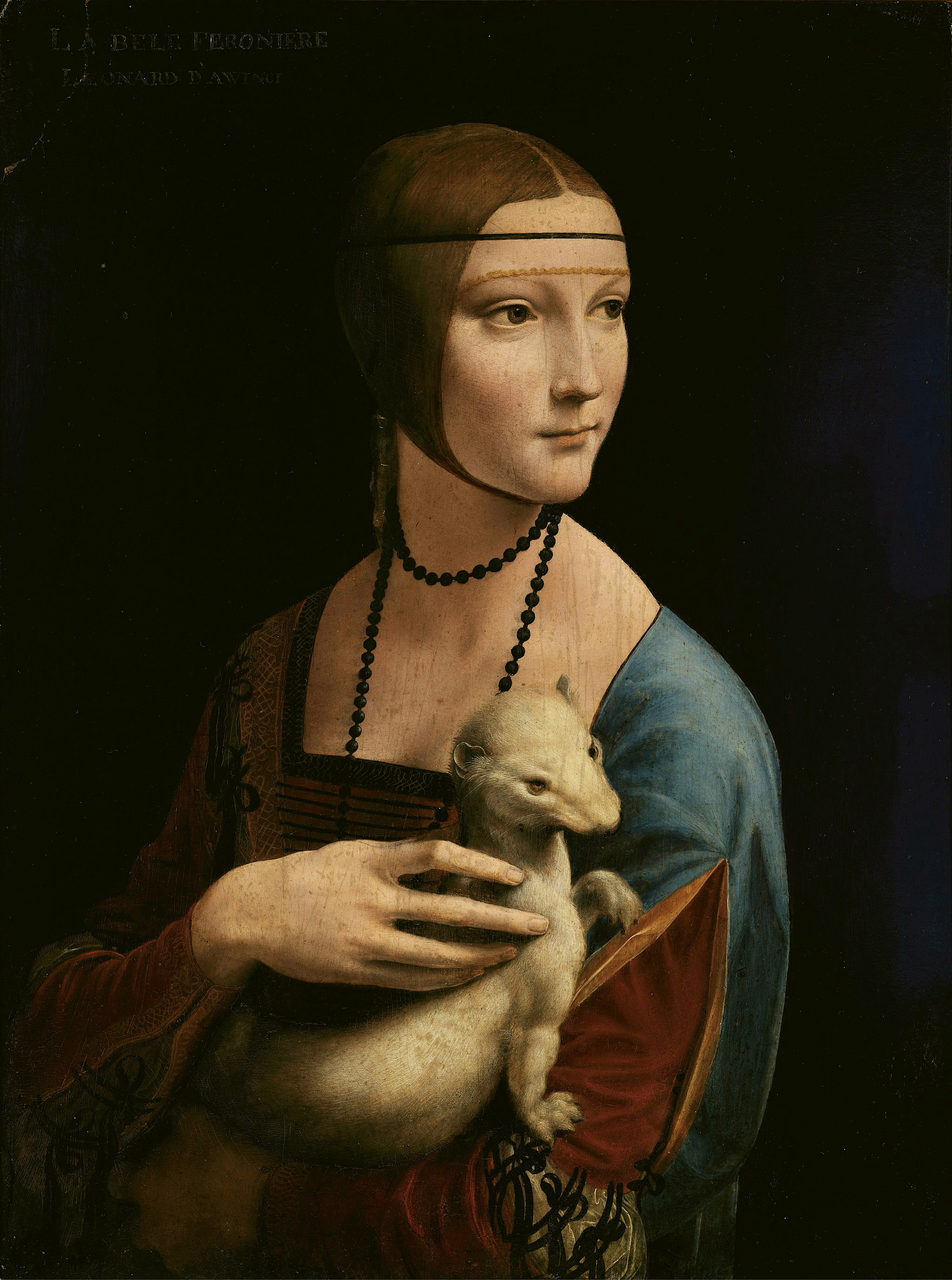
Google Arts & Culture — niveaux ajustés par UpdateNerd · Domaine public — PD-Art / Public Domain Mark 1.0
Compare the shoulders and face: they do not point in exactly the same direction. This difference suggests that Cecilia has just turned her head. The portrait seems to capture a movement rather than a motionless pose.
Cecilia looks at something we cannot see. Her attention beyond the painting suggests a presence or event, without allowing us to identify it. The frame no longer contains the whole story.
The animal’s head turns towards the same side as Cecilia’s. This shared movement connects them and strengthens the impression that they are responding to something outside the painting.
Follow the fingers resting along the ermine’s body. The hand visually connects the young woman and the animal, inviting us to imagine skin touching fur. The portrait almost engages our sense of touch.
Look closely
Compare the direction of the torso with that of the face. Cecilia seems to turn her attention towards something outside the painting. We can imagine a presence without knowing whom or what she sees.
Notice the animal too: its head echoes this movement. The long hand on its fur connects the two living beings, while light brings out the face, hand and pale body of the ermine.
Understanding
The portrait depicts Cecilia Gallerani, an educated young woman associated with Ludovico Sforza’s court in Milan. The turn of the head and direction of her gaze suggest a moment caught in passing.
Leonardo goes beyond describing an appearance: the portrait suggests attention shifting towards something else. The ermine adds to this living presence while allowing several symbolic readings.


How to recognise Léonard de Vinci?
Gestures Connecting the Figures
Hands and glances guide our attention and give meaning to the relationships between the figures.
Soft Transitions Between Shadow and Light
Forms are modelled gradually; contours may dissolve instead of closing with a line.
Attention to the Living World
Plants, wings, bodies and landscapes invite us to observe how Leonardo builds the appearance of nature.
Emotion Made Visible
A leaning body, open hands or a turn suggest an inner response.
A Presence in Motion
The figures seem caught in an action or a shift of attention extending beyond the frame.
Key takeaways
In Leonardo’s paintings, look for what connects the figures: a glance, a hand, a light or a movement. The composition directs our attention and suggests what the figures experience.
His investigations of nature and perception give this presence its force. Painting becomes a way of making life visible, even in its elusive aspects.
Poursuivre la découverte
Return to the workshop where Leonardo trained and to The Baptism of Christ.
Return to the comparison of Leonardo’s and Filippino’s Adorations of the Magi.
Pour aller plus loin
The official record of this early painting.
The Louvre version, its commission and questions of interpretation.
France Culture · Les Chemins de la philosophie · Podcast in French After exploring the gestures, light and landscape, continue discovering the painting with this episode devoted to The Virgin of the Rocks.