Sandro Botticelli
1445–1510
From Florence to the world of antiquity, Botticelli gives stories the rhythm of a gesture, a fold of cloth or a glance.
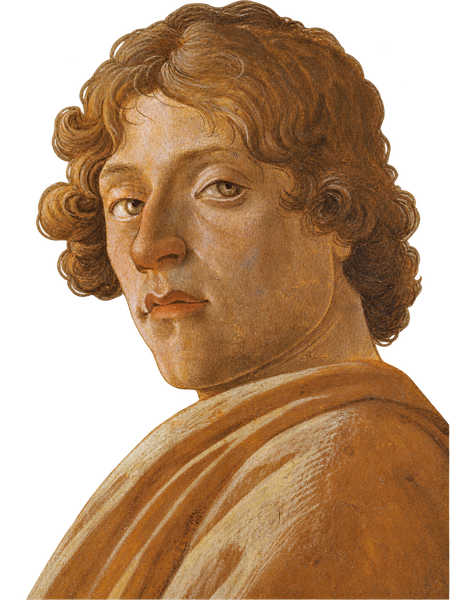
In a few words
Born in Florence around 1445 as Alessandro Filipepi, Botticelli trained in Fra Filippo Lippi’s workshop. He worked for churches and leading Florentine families. In Rome, he helped decorate the Sistine Chapel. Religious commissions continued throughout his career. In Florence, he also brought ancient stories into ambitious large-scale paintings such as Primavera and The Birth of Venus.
Adoration of the Magi
Look closely
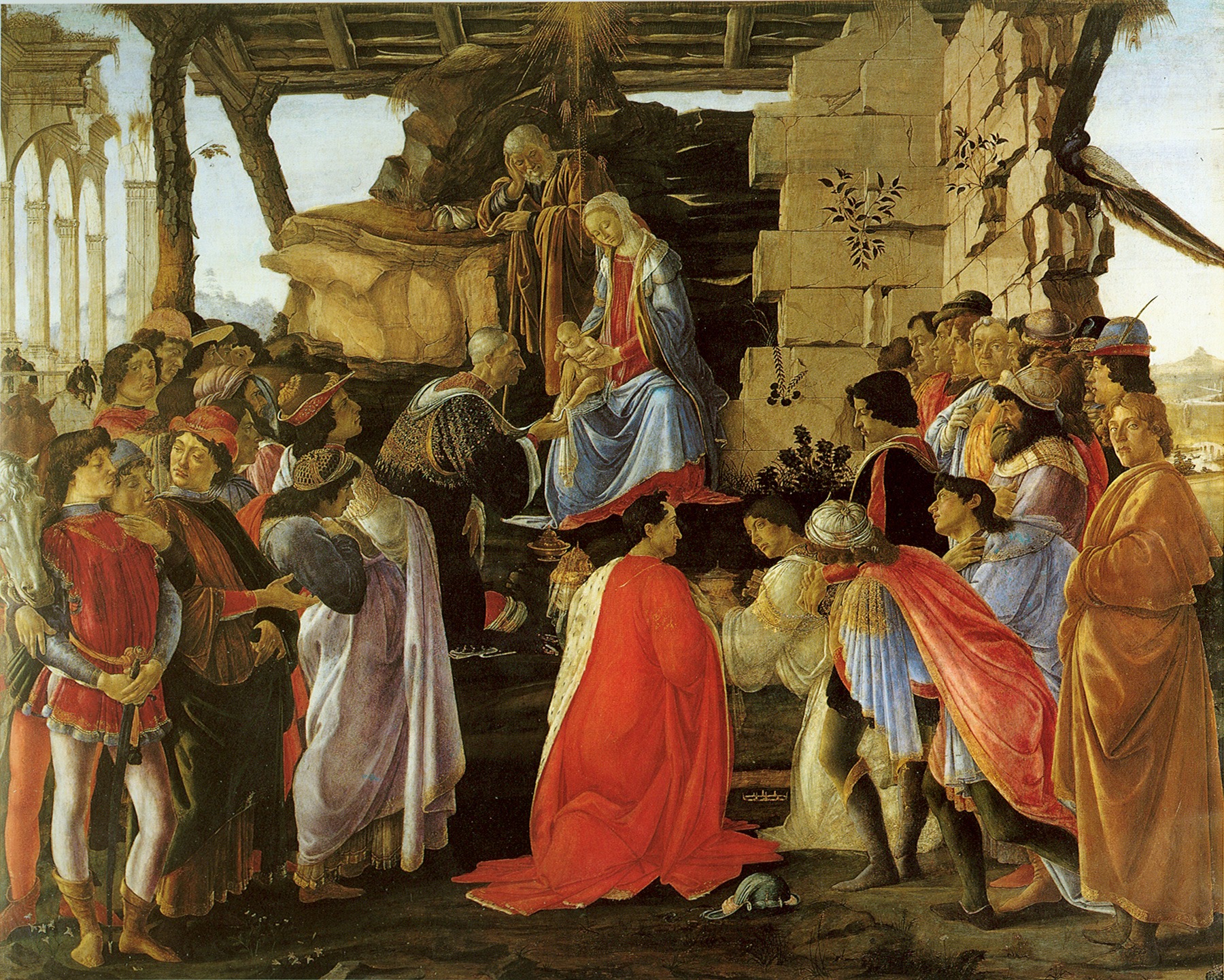
Find the Child sitting on Mary’s lap amid the ruins. Look down at the kneeling Magus. His hands, covered by a cloth, reach towards Jesus’s foot. Notice how the figures are arranged on either side, leaving this small gesture clearly visible.
At the far right, look for the man in the ochre cloak. As the Magus bows, this man turns his face towards us.
Understanding
Giving Florence a place in the sacred story
Botticelli puts the Magus’s act of devotion at the centre. Around him, the crowd takes on the features of Florentine society. Vasari identified the kneeling elder as Cosimo the Elder, who died several years before the painting was made. If the identification is correct, his place beside the Child pays tribute to his family. The painting was made for its patron, Guasparre del Lama, for his chapel in Santa Maria Novella.
On the right, the man in the ochre cloak is traditionally identified as Botticelli himself. His gaze draws us into the gathering, where the figures of the Gospel and the faces of Florence meet.

The Birth of Venus
Look closely
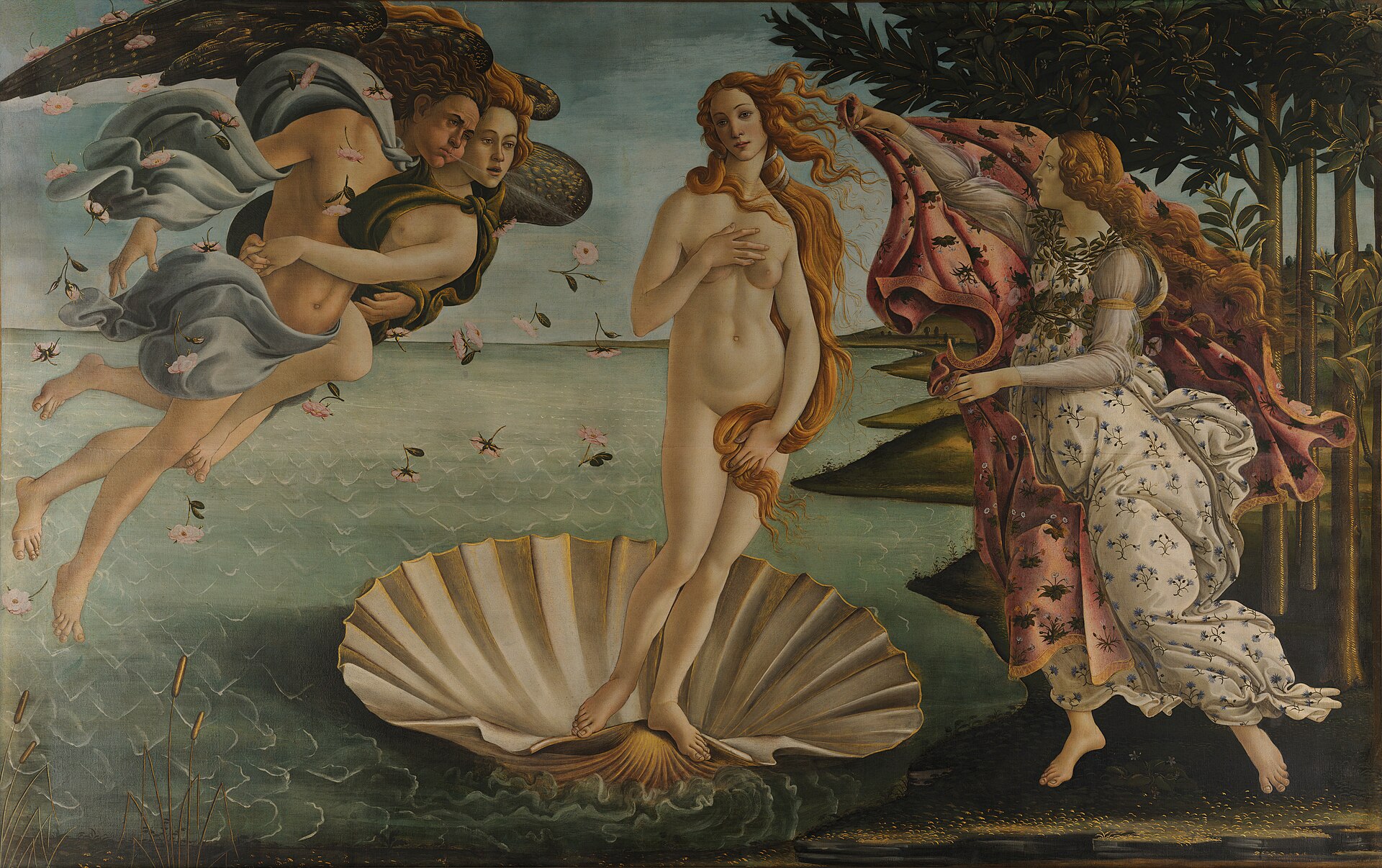
On the left, find Zephyr, the west wind. His puffed cheeks and parted lips show where the wind comes from. A winged figure embraces him, sometimes identified as Aura, the breeze. Follow the roses as the wind carries them towards the centre.
Standing on the shell, Venus covers her breast with one hand and draws her hair across her body with the other. On the shore to the right, a young woman leans towards her and holds out a flowered cloak. She is often identified as the Hora of Spring, a personification of the season. Notice the gap between the edge of the cloak and Venus’s shoulder.
Understanding
Holding the story at the moment of arrival
Botticelli chooses the moment when Venus, born from the sea foam, approaches the shore. On the left, the roses and her streaming hair make visible the wind that carries her towards land. On the right, the cloak reaches out to meet her. The gap between them lets us imagine what happens next. In a moment, Venus will be covered. Uffizi Galleries
Amid this movement, Venus’s silhouette stands out against the sea. Her gesture recalls the classical statues known as Venus Pudica. Botticelli makes that sculptural pose the still point of the composition. The movement of the figures and fabrics makes the moment feel fleeting, while the goddess’s outline invites us to linger.
Primavera (Spring)
Look closely
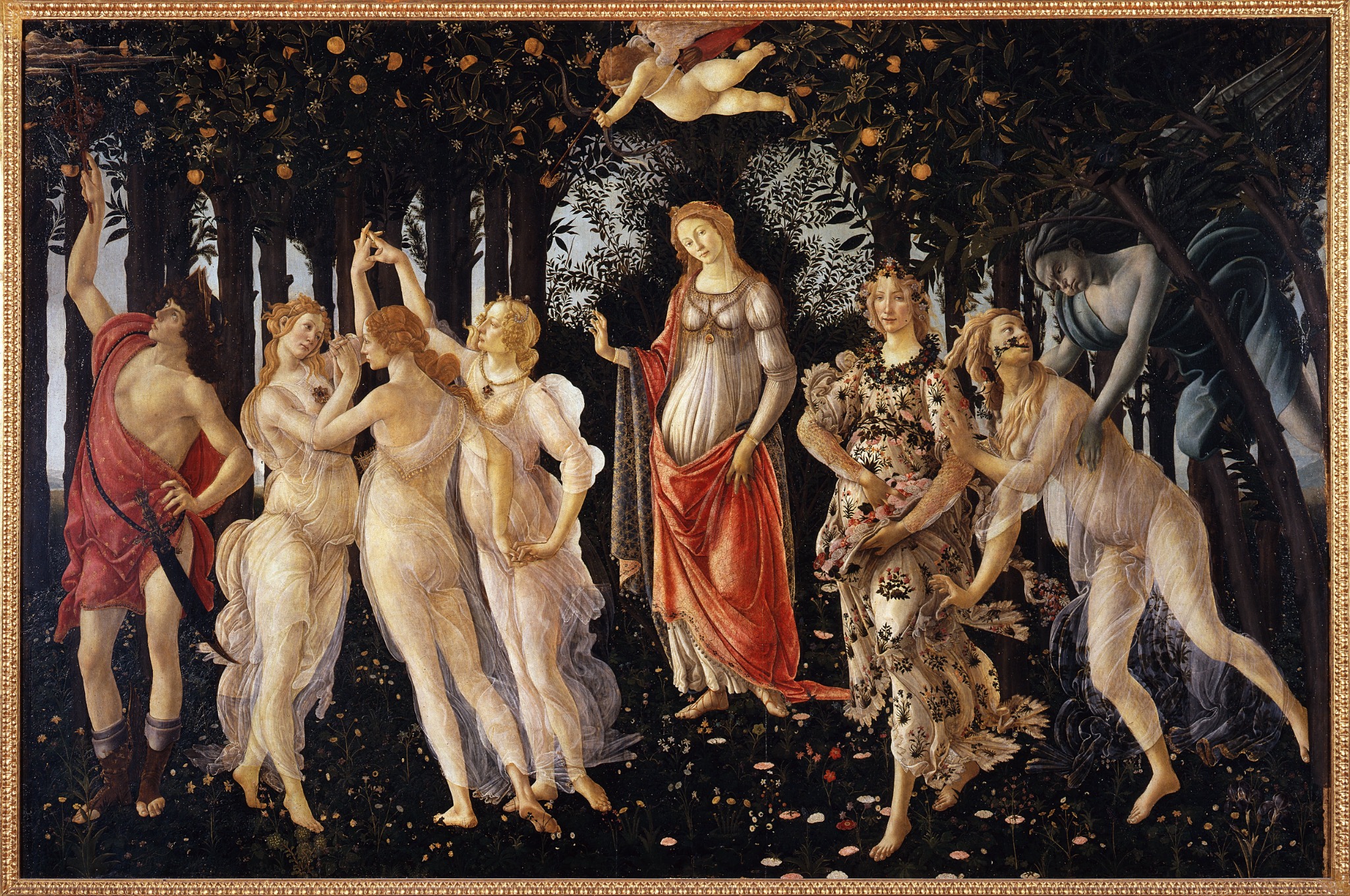
Begin on the right. Zephyr, the west wind, is the winged figure with bluish skin emerging from the trees. He seizes Chloris, a nymph who turns her head towards him. Look at the flowers spilling from her mouth. Just beside her, Flora, recognisable by her flowered dress, scatters roses from a fold of her gown.
In the centre, Venus stands slightly back beneath an opening in the foliage. Above her, blindfolded Cupid aims his arrow towards the Three Graces. Follow their joined hands as they trace the movement of the dance. At the far left, Mercury turns his back on them. Look for his winged sandals and the staff he raises towards a cloud.
Understanding
Making a transformation visible
In Ovid’s Fasti, Flora tells how she was once called Chloris. Botticelli paints the same figure twice, side by side. The flowers spilling from the nymph’s mouth mark the beginning of the change. With Flora, they cover her gown and scatter across the ground. As our eyes move from one figure to the other, we see the transformation take place.
Botticelli gives each group its own rhythm. On the right, Zephyr and Chloris are drawn close together. On the left, the raised arms of the Graces carry the curves of their dance. Between them, Venus’s position slightly behind the other figures and the opening in the foliage give her a central place. Above her, Cupid’s arrow directs our eyes towards the dancers. The arrangement leads us from pursuit to dance. The meaning of the mythological gathering as a whole remains open to debate
The Calumny of Apelles
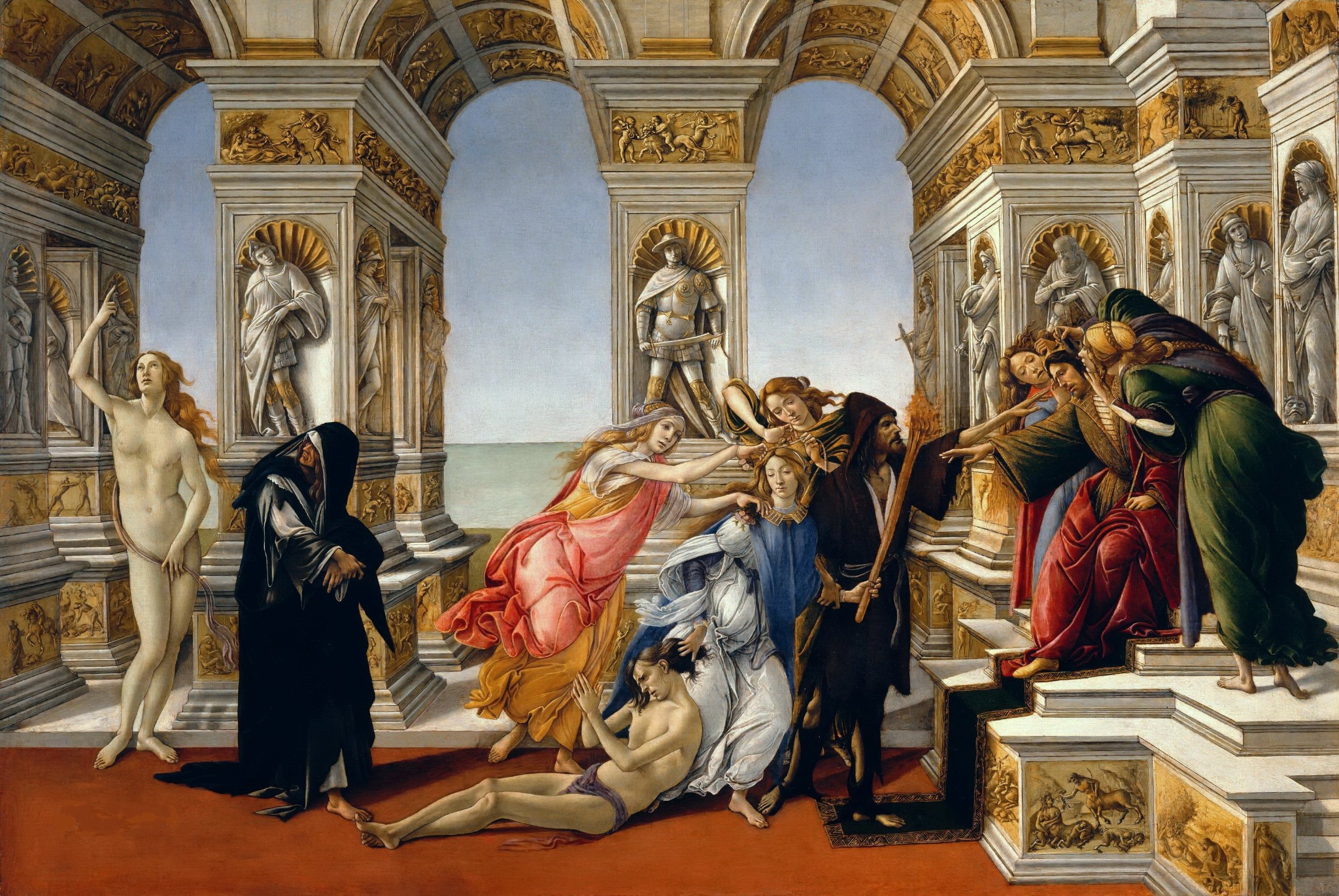
Ignorance and Suspicion lean in to whisper to the king. Look at his donkey ears and his outstretched hand.
Calumny drags the innocent man by his hair. Follow her arm to the hand gripping his hair, then look at his clasped hands.
Penitence turns towards Truth. Follow her gaze to the naked woman, the only figure pointing towards the sky.
Look closely
Start on the right with the judge with donkey’s ears, who recalls King Midas. Two women lean close to his ears, Ignorance and Suspicion. Follow the arm he extends towards the approaching group. The bearded man in dark clothes leading it is Rancour.
In the centre, find Calumny by her torch. With one hand she drags a young man by the hair. Behind her, Fraud and Deceit arrange her hair. Look at the clasped hands of the almost naked young man down on the floor.
On the left, Repentance, dressed in black, turns towards Truth, who stands naked and raises a finger towards the sky. Notice the space between her and the group. Who in the scene turns to look at her?
Understanding
Showing how an accusation gains the upper hand
Botticelli takes his starting point from Lucian of Samosata’s description of a lost painting by the Greek artist Apelles. He gives abstract ideas tangible gestures. At the foot of the throne, the young man clasps his hands in appeal, while Suspicion and Ignorance already have the judge’s ear. In the centre, two women attend to Calumny’s appearance even as she mistreats the accused. The simple act of arranging her hair makes the work of deception visible.
Truth’s position completes the scene. Apart from the procession, she stands upright with one arm raised. That vertical line brings our gaze to a stop at the edge of the panel. The judge listens to those around him. Botticelli gives us time to look at the figure he ignores.
You turn !
In The Birth of Venus, you recognise me instantly. In Primavera, I am more discreet, but I still occupy the centre of the scene. Who am I?
One last challenge: find another character who appears in both paintings.
How to recognise Sandro Botticelli?
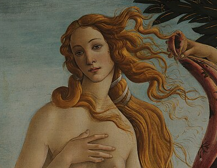
Outlines that guide the eye
Follow a lock of hair, an arm or a fold. See where its curve carries over into another form.
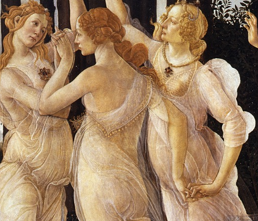
Poses that establish a rhythm
Compare the tilt of the heads, the length of the necks and the shape of the fingers. A slight tilt can change the bearing of an entire figure.

Gazes that create a pause
Notice where the eyes settle. A thoughtful face can hold your attention amid a composition full of movement.
A detail that carries the story forward
Ask what a flower, a jewel or the edge of a garment is doing. A rose swept along by the wind can show its direction.
Key takeaways
In Botticelli, line shapes the story. An outline can steady a figure, extend a gesture or carry movement from one person to another. That is what connects these four works, from altarpiece to mythology and allegory.
In the Adoration, the arrangement of bodies and the direction of their gazes draw a Florentine crowd around the Child. In The Birth of Venus, hair, roses and a cloak make the direction of the wind visible. In Primavera, the Graces’ interlaced arms give their dance a rhythm distinct from the pursuit of Chloris. In the Calumny, a chain of hands carries the accusation towards the judge.
Botticelli brings ancient stories into Florentine painting using devices he also employs in his sacred pictures.
To recognise his approach, follow a hand, a fold or a lock of hair. See where the line leads you and what part it plays in the scene.