Mary’s Marriage: A Flowering Branch and Broken Hopes
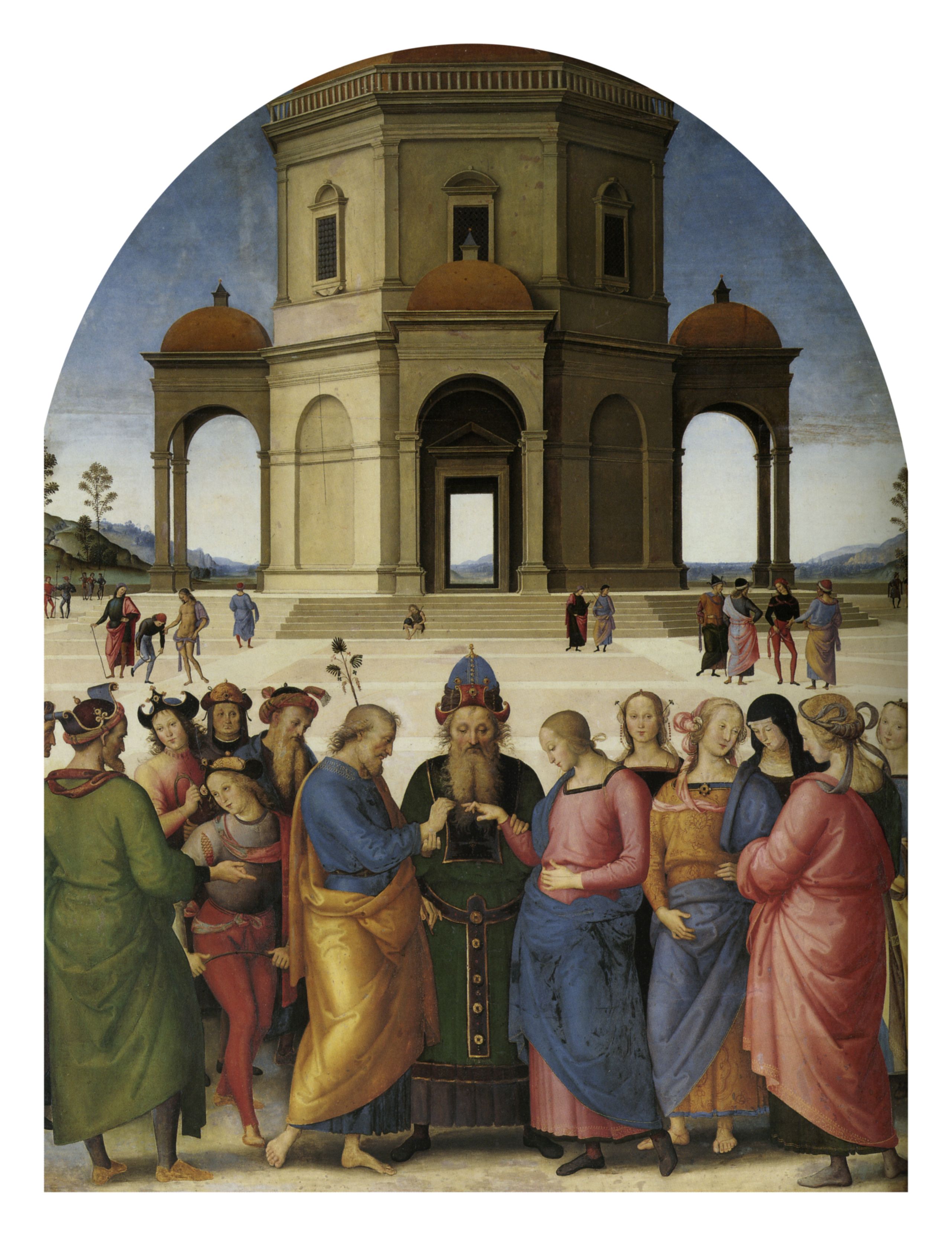
Why is Joseph holding a flowering branch? And why is a man breaking his own against his knee? Behind the peaceful ceremony lies a story of a miraculous choice and disappointed suitors.
According to the tradition recounted in apocryphal writings and the Golden Legend, Mary grew up in the Temple in Jerusalem. When the time comes to choose a husband for her, the priest asks the eligible men to bring a wooden staff. A divine sign will reveal the chosen man.
Joseph’s staff miraculously blossoms. Neither youth, wealth nor strength determines the marriage: in this story, God makes the choice.
Look at Joseph’s branch. Its flowers are small, but they explain why he is standing beside Mary. The other suitors retain their dry staves, now reminders of their rejection.
Not everyone accepts this outcome calmly. Some break their staves in frustration. In Raphael’s painting, one man bends forward in the foreground and forces his staff against his knee. His abrupt movement contrasts with the ceremony’s measured gestures: the couple’s happiness is set against the rejected man’s disappointment.
At the centre, Joseph places the ring on Mary’s finger in the priest’s presence. On one side, a branch blossoms and a union begins; on the other, a branch breaks and a hope comes to an end.
The temple and perspective give the scene its majestic order. But the small objects tell the story: a staff, a few flowers, a ring.
This story belongs to the Christian tradition drawn from apocryphal writings and later circulated notably through the Golden Legend. These details do not appear in the four canonical Gospels.