Why does a severed head appear at the banquet?
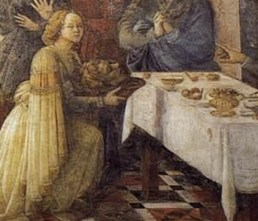
The Feast of Herod brings to a climax a conflict recounted in Matthew (14:1–12) and Mark (6:17–29). John the Baptist condemns Herod Antipas’s marriage to Herodias, his brother’s wife, and is imprisoned. During a banquet, Herodias’s daughter — traditionally named Salome — dances before the guests. Delighted, Herod promises to grant her a request. Prompted by her mother, she asks for John’s head.
Lippi does not paint a single frozen instant. He brings successive episodes together within one architectural setting. Follow the dancer, look at the guests around the table, then find the head presented on a platter. The sequence of gestures carries the narrative forward, almost like an early visual storyboard.
The contrast is unsettling: beautiful fabrics, elegant architecture and festive ceremony surround an act of brutality. That tension gives the fresco its power. We begin by admiring the spectacle and gradually discover the violence beneath it — and the terrible cost of a reckless promise.