Lucrezia Buti: did the Virgin have a familiar face?
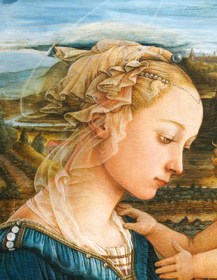
Filippo Lippi was a Carmelite friar, yet his life did not always follow the rules of the convent. While working in Prato, he formed a relationship with Lucrezia Buti, who was associated with a religious institution in the town. Their story, retold and embellished over time, led to two children, including Filippino Lippi, who would become a painter himself.
The Madonna’s tender, recognisably human face has inspired an enticing suggestion: could Lippi have given Mary Lucrezia’s features? There is no firm evidence. Identifying a real-life model in a sacred figure is difficult, particularly when contemporary documentation is scarce.
The story nevertheless helps us look more closely. Lippi makes the sacred feel immediate and familiar: Mary is not a distant icon, the angels behave almost like children, and one meets our gaze directly. The biography enriches our response to the painting, but it cannot settle the identity of the model.