Fra Angelico
Vers 1395–1455
A head tilts, hands come together, two figures meet each other’s gaze. Fra Angelico brings sacred stories to life through gestures we all recognise.

In a few words
Born around 1395–1400 in the Mugello, near Florence, Guido di Pietro became a Dominican friar and took the name Fra Giovanni. He painted altarpieces for churches and worked with his workshop on frescoes for the Florentine convent of San Marco. He also worked in Rome, where he died in 1455. An altarpiece and a fresco that the friars passed in their daily rounds served different purposes.
As you look at each work, ask yourself what draws you into the scene and where Fra Angelico invites you to pause.
The Coronation of the Virgin
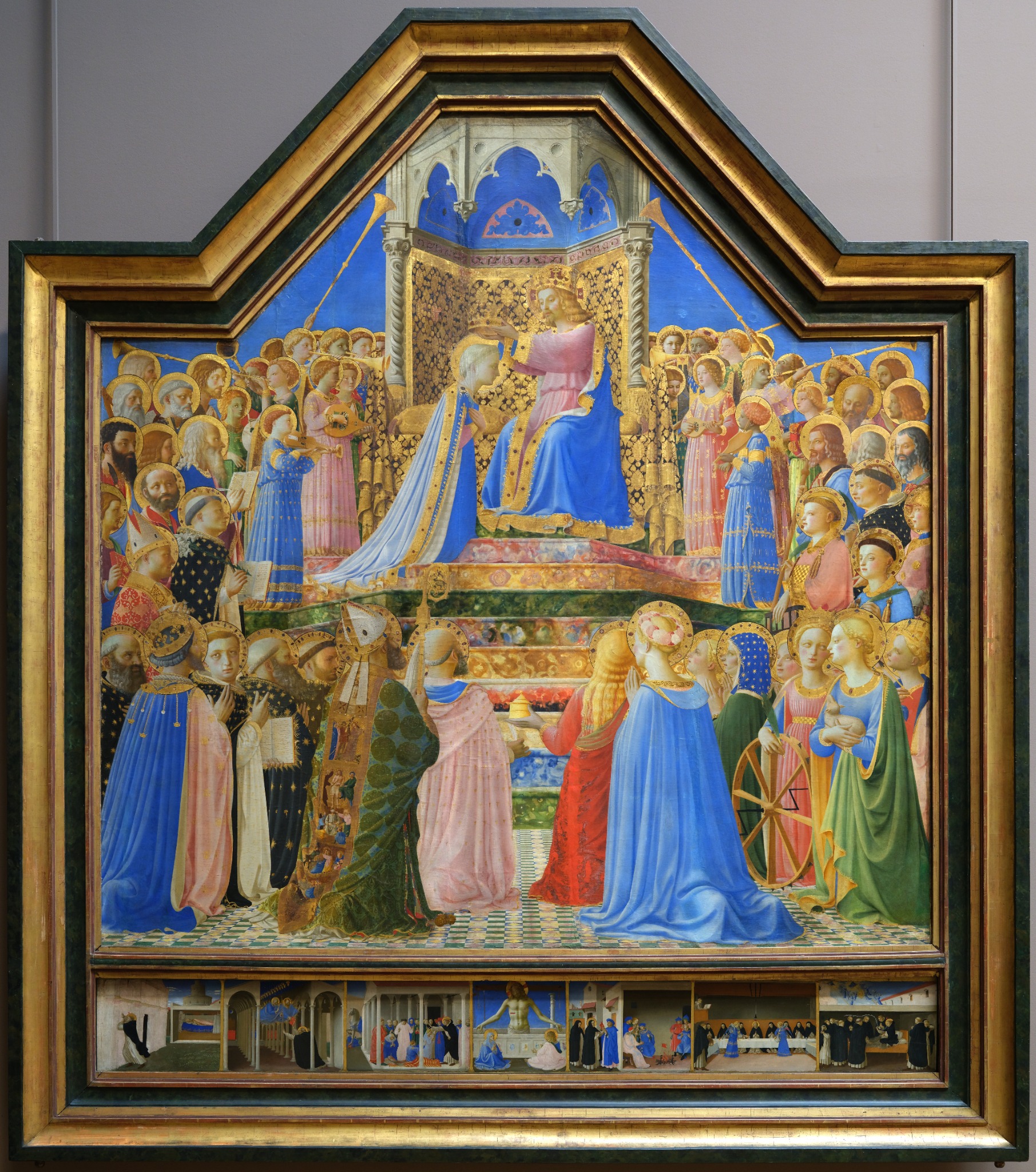
- Marble steps
- Christ’s gesture
- Figures seen from behind
Look closely
Start with the kneeling figures in the foreground, some seen from behind. Follow the coloured marble steps up to the throne. At the top, Christ places a crown on the head of Mary, who bows before him. Saints and angels gather on either side of the steps, leaving a clear path towards the two central figures.
Understanding
Steps that lead into heaven
The figures seen from behind put you in a position where you can imagine joining the assembly. The steps give your eye a distance to travel. At the top, Christ’s gesture becomes the focus of the whole scene. Fra Angelico keeps the brilliance of gold while giving heaven the depth of a place you can imagine walking into.
The Last Judgment
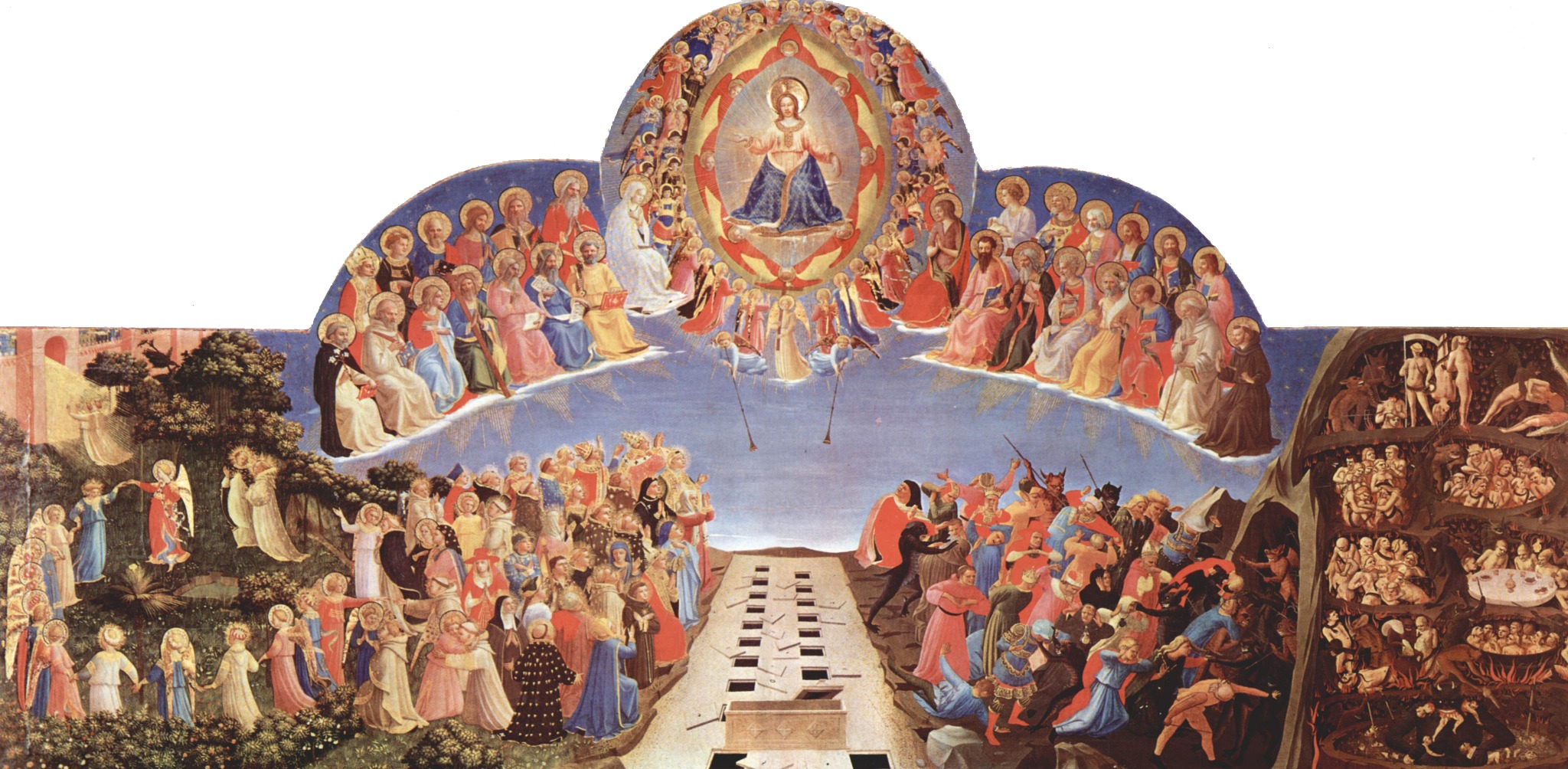
- Christ as judge
- Open tombs
- The dance in heaven
- The entrance to hell
Look closely
At the top centre, find Christ seated among the angels. Directly below him, follow the row of open tombs towards the horizon. On your left, figures join hands in a garden. On your right, demons drive the damned towards the dark entrance to hell.
Understanding
Two paths on either side of the tombs
The row of tombs gives the landscape depth and divides the two groups. On the left, linked hands and the steps of the dance make heaven a place where people move together. On the right, figures are driven onwards by force. In a painting crowded with dozens of figures, Fra Angelico makes these two destinies clear through the way the bodies are arranged.
The Deposition from the Cross
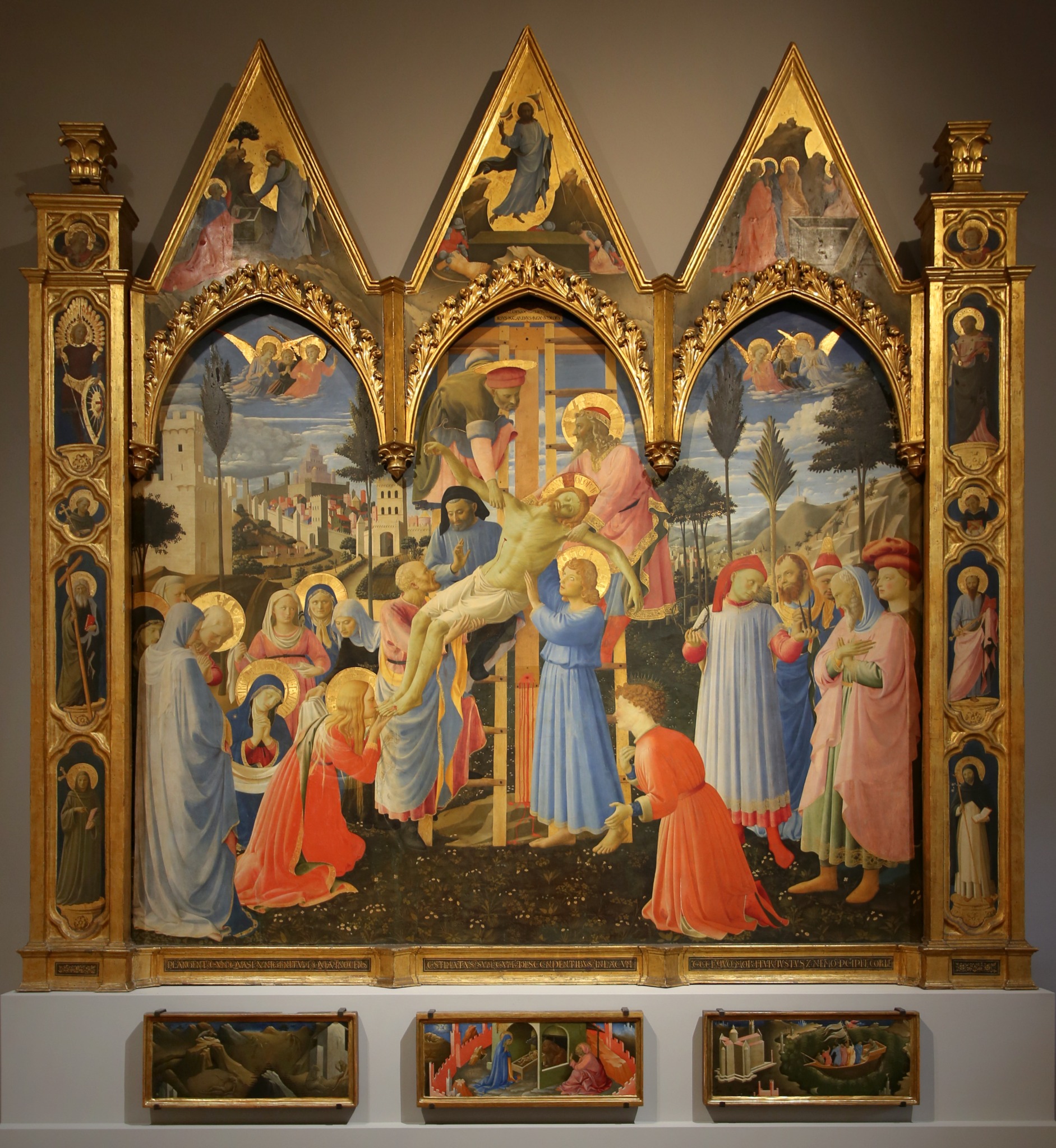
- Supporting hands
- Mary Magdalene
- The crown and nails
Look closely
At the centre, follow Christ’s body from shoulder to feet. Find the hands supporting him as he is lowered. At the lower left, Mary Magdalene bends towards his feet. Then follow the landscape behind the figures. Walls and hills continue from one side of the panel to the other.
Understanding
Several hands bear the weight
The tilted body and the hands supporting it make you feel the weight of Christ as he is lowered. Mary Magdalene’s gesture draws attention to his feet and shows another way of taking part in the scene. The continuous landscape behind the figures brings the groups together beneath the three points of the altarpiece. In this work begun by Lorenzo Monaco, Fra Angelico fits a single moment into a space that extends across the whole panel.

The Annunciation at San Marco
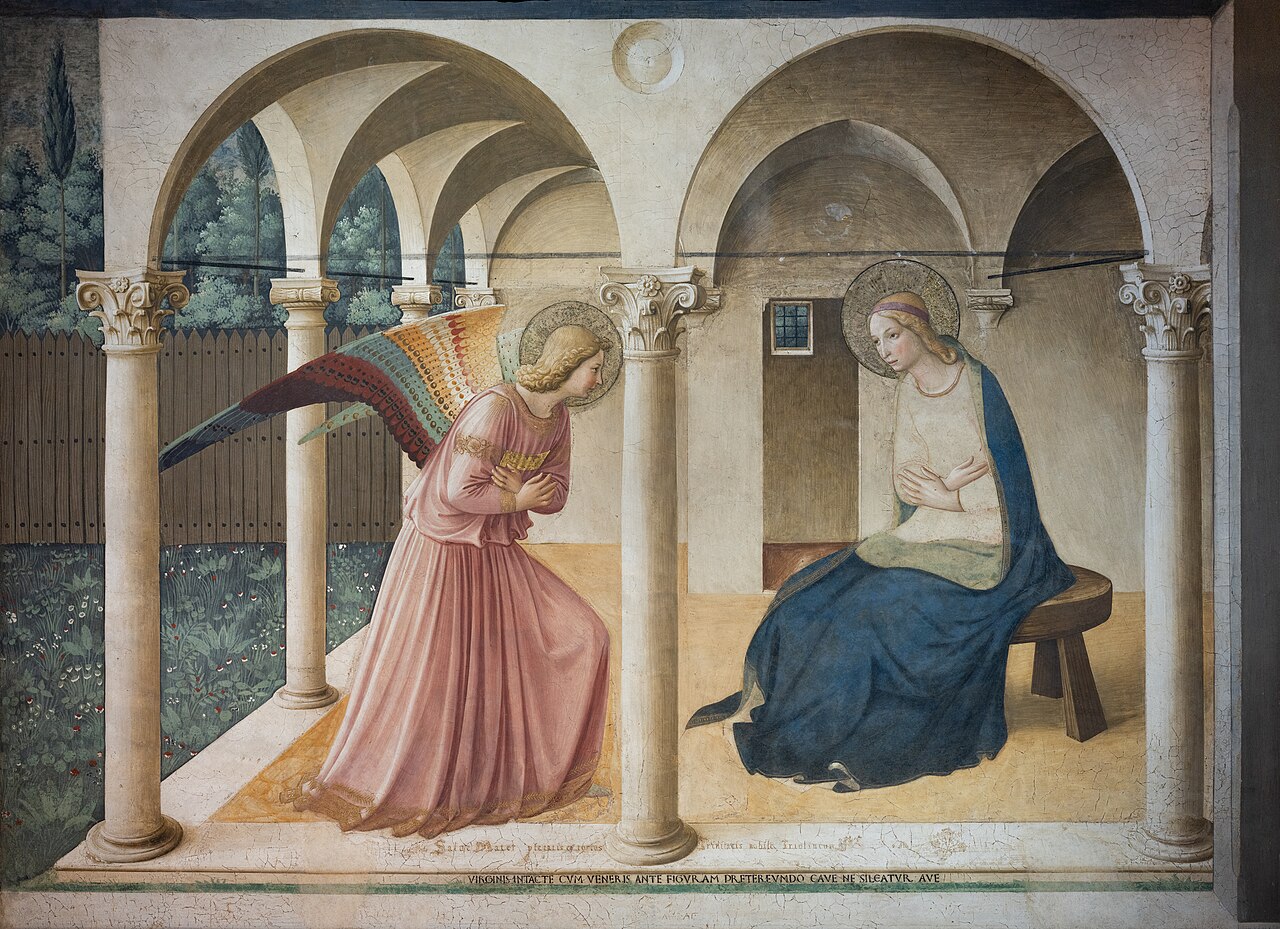
- Gabriel
- Mary
- The inscription
Look closely
Under the portico, look first at Gabriel kneeling on the left, then at Mary seated on the right. Compare their crossed arms and slightly bowed heads. Follow the arches towards the back, then return to the pale column between them.
Understanding
A response you can see in a gesture
The column marks the distance between Gabriel and Mary. The echo between their gestures takes your eye from one figure to the other. The movement of your gaze gives visible form to the exchange in the biblical story. In the convent, the fresco meets the friars at the head of the stairs leading to the dormitory. The painted portico and its columns echo the architecture they have just walked through. The encounter seems to take place close at hand.
Smarthistory — The Annunciation at San Marco · Guide accessible de Florence — L’Annonciation du couloir nord
Explore further — Benozzo Gozzoli
Look closely
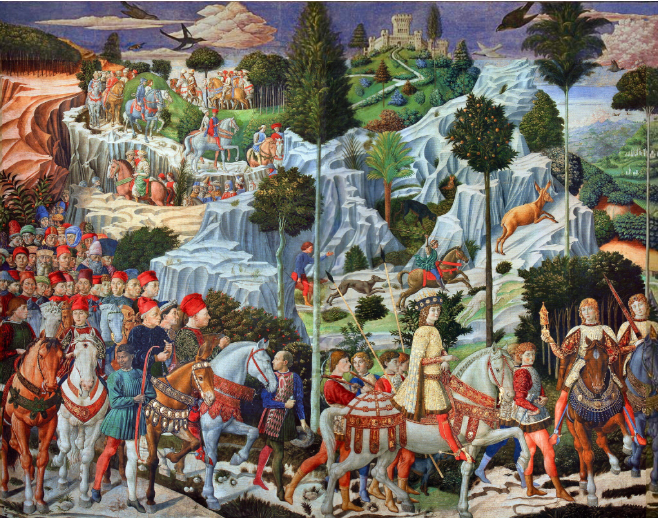
Follow the riders along the painted road. Pause over the patterns of their clothes and the horses’ trappings, then pick up the procession’s route across the hills.
Understanding
A story that unfolds along the walls
Benozzo Gozzoli had worked with Fra Angelico. In the Medici chapel, he uses fabrics and horse trappings to give each group its own splendour. The riders’ journey links these details along the walls. You discover the story by turning your head and letting your eyes travel around the chapel.
Palazzo Medici Riccardi — La chapelle des Mages · Palazzo Medici Riccardi — Benozzo Gozzoli
How to recognise Fra Angelico?
Colours your eye can follow
Look for a colour that recurs from one figure to the next. In the Coronation, the reds and blues of the clothes catch your eye as it moves up towards the throne.
Gestures that echo each other
Compare the hands of two figures. In the Annunciation, Gabriel’s crossed arms echo Mary’s. That gesture is enough to link the two figures.
Lines that lead you into the distance
Follow a row of objects that repeat and grow smaller. In the Last Judgment, the tombs lead your eye from the foreground to the horizon.
Feeling you can read in the hands
Look at what the hands are doing before you read the faces. In the Deposition, hands support Christ while Mary Magdalene bends down and touches his feet. Each gesture gives a figure their own way of taking part in the mourning.
Key takeaways
Fra Angelico uses depth, colour and gesture to give you a place in the picture. The steps in the Coronation draw you into a gathering. The tombs in the Last Judgment separate two paths. In the Deposition, a few hands let you sense what it takes to lower Christ’s body.
At San Marco, a handful of arches frame a meeting. When you next see a Fra Angelico, notice which detail first catches your eye. Then follow the line, colour or gesture that draws you elsewhere.
Poursuivre la découverte
After the *Annunciation*, look at Piero’s *Baptism of Christ*. Follow John the Baptist’s gesture and see which detail it leads you to.
Pour aller plus loin
France Culture · *Toute une vie*. A French-language episode about the painter and Dominican friar.