Antonello de Messine
vers 1430–1479
The art of shaping distance. Where does Antonello place the viewer?
In a few words
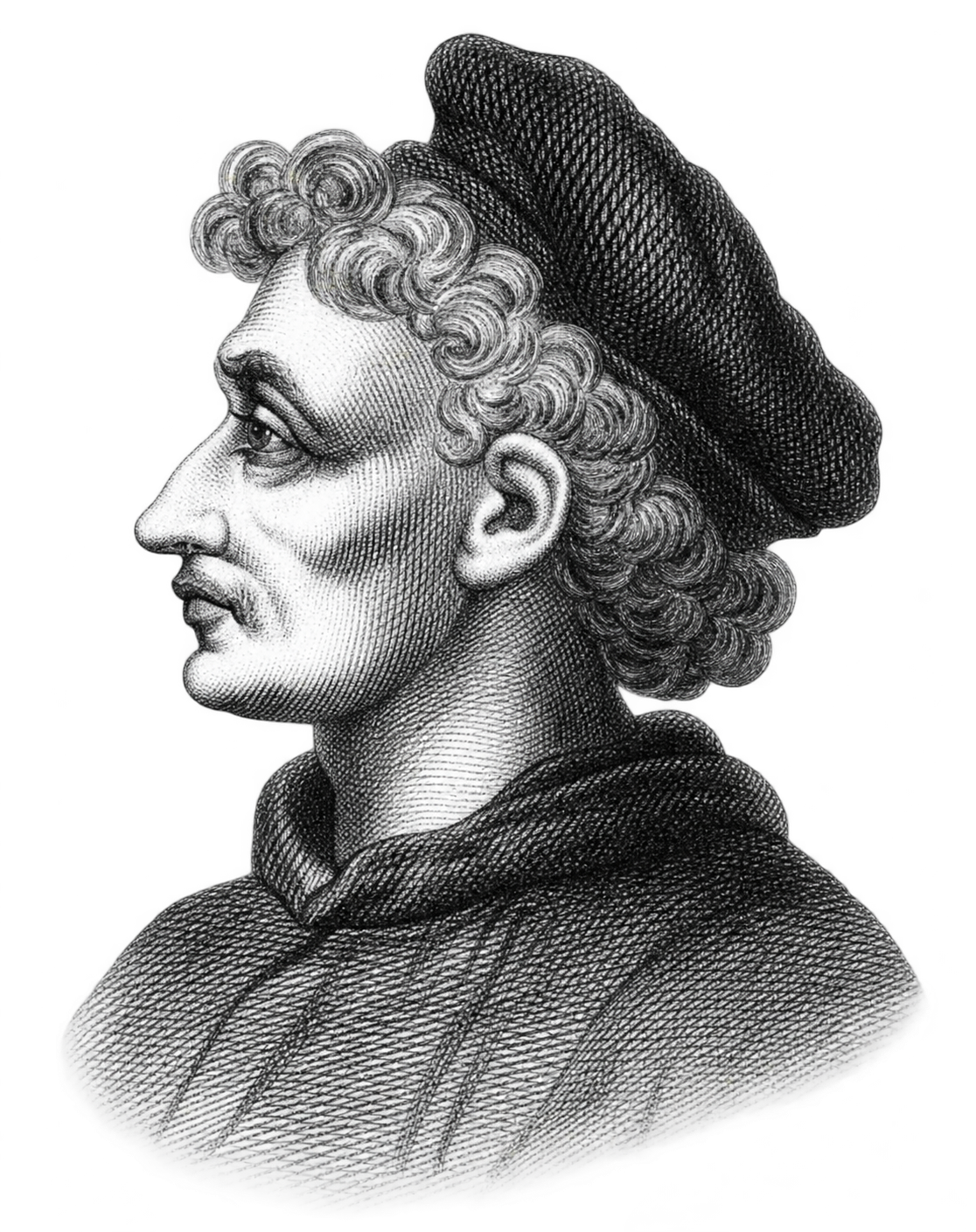
Active in Sicily, Naples and Venice, Antonello da Messina painted at a time when works from the Low Countries circulated in Italy. He drew on their precise observation and the possibilities of oil paint. These qualities are apparent in the modelling of a cheek and in the way a piece of furniture or a threshold locates figures in space.
Portrait of a Man, known as Il Condottiere
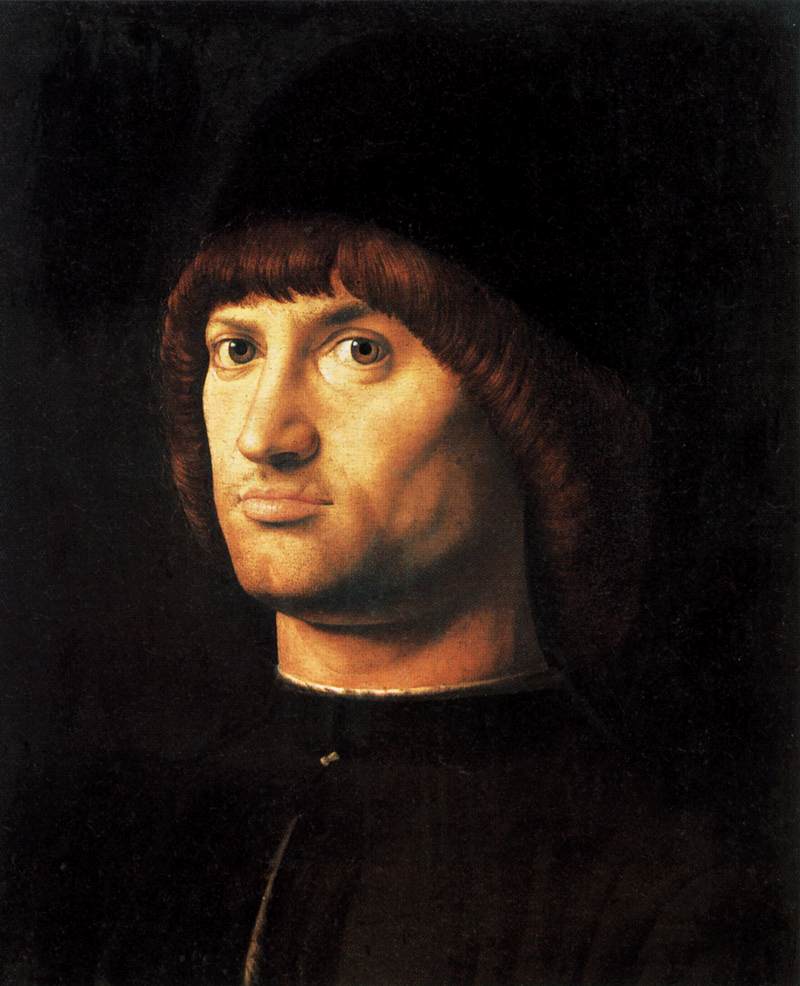
Use the line as a starting point. Imagine extending it to the tip of the nose, then compare its direction with that of the gaze.
Follow the pale curve below the neck. It helps you read the position of the bust where the dark clothing almost disappears into the background.
Look closely
First look at what stands out from the background. The dark cap and clothing almost merge with it. A thin pale line marks the collar, and the light picks out the face. Follow it from the cheekbone into the shadow beneath the jaw.
Now compare the turn of the head with the direction of the eyes. The nose points towards the left of the painting. The eyes seem to turn back towards you. Notice the closed mouth as you meet the sitter’s gaze.
Understanding
Giving the sitter a presence of his own
In 1475, profile portraits were still common in Italy. Here Antonello adopts a formula inspired by Netherlandish painters, showing the sitter in three-quarter view against a dark ground. Oil paint lets him modulate the transitions from light to shade, giving volume to the cheek and jaw. The clothing merges into the darkness, drawing our attention to the sitter’s features.
Antonello uses the pose to achieve a precise effect. The body is already turned away and the eyes seem to have just settled on us. That slight difference introduces a sense of movement into a still figure. The closed mouth leaves the meaning of the gaze open. The painter gives the sitter the initiative in the encounter.
Virgin Annunciate (Palermo)
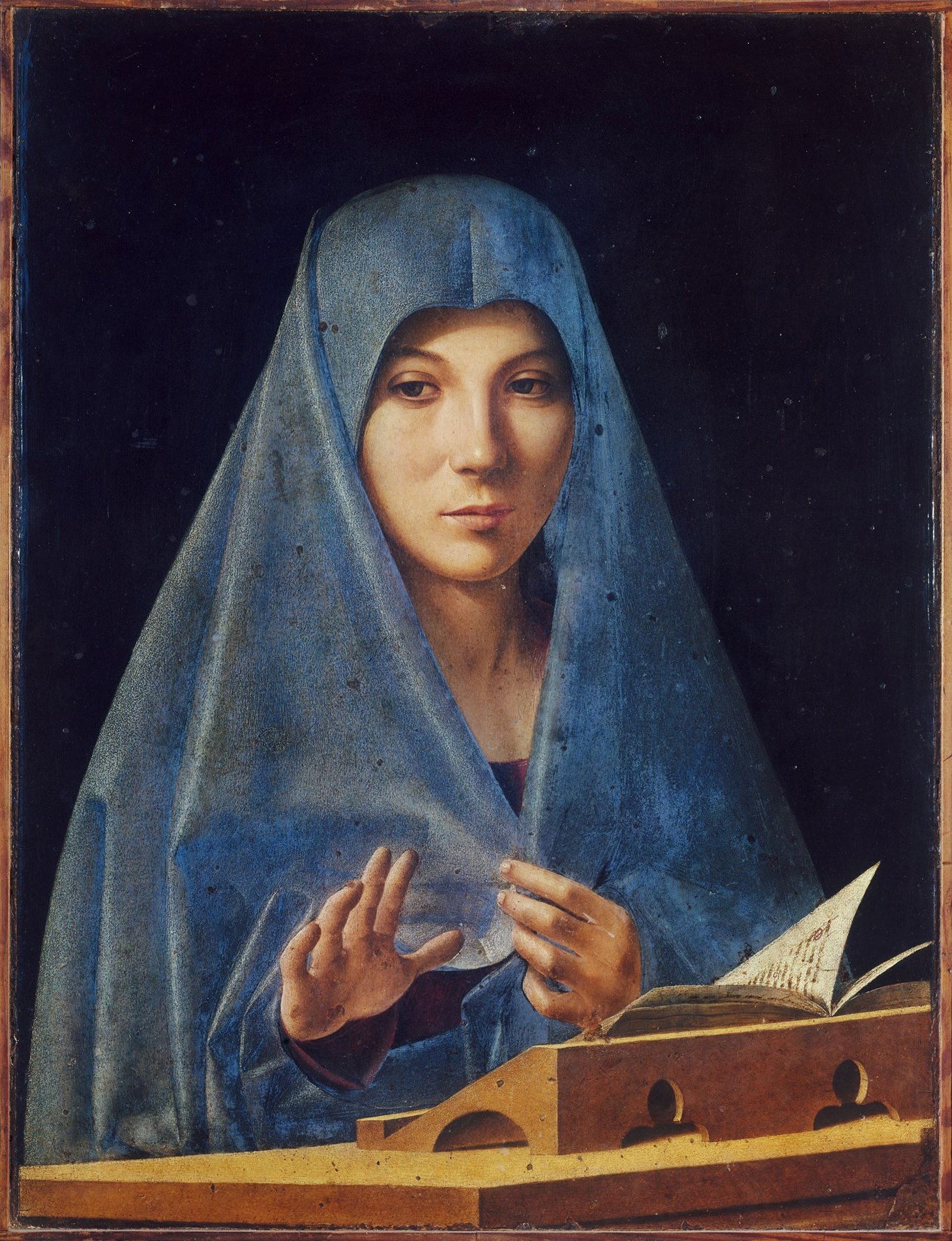
Start at the corner where the two lines meet. Follow one to the left, then the other to the right to see how the lectern is angled.
Compare the extended fingers with those of the other hand against the veil. Their apparent length changes with their direction in space.
Look closely
Compare Mary’s two hands. Her left gathers the veil against her chest. Her right reaches out above the lectern, its fingers slightly spread. The corner of the lectern, set at an angle, points towards the lower edge of the painting.
Look up at her face. Beneath the blue veil, her head is almost frontal. Her eyes turn slightly downwards and towards the left of the painting. Follow their direction and see where it leads your eye.
Understanding
Painting a message through the person who receives it
Antonello composes an Annunciation with a single figure. The foreshortened right hand gives depth to the narrow space between Mary and the edge of the painting. Her other hand, gathering the veil, brings our attention back to her body. Together, these gestures animate a figure whose face remains almost still.
Mary’s gaze gives the scene a direction. It suggests Gabriel’s presence beyond the frame. Antonello lets us perceive the announcement through its effect on Mary. A sideways glance and a hand held in mid-air are enough to give the moment the sense of an exchange

Saint Jerome in his Study
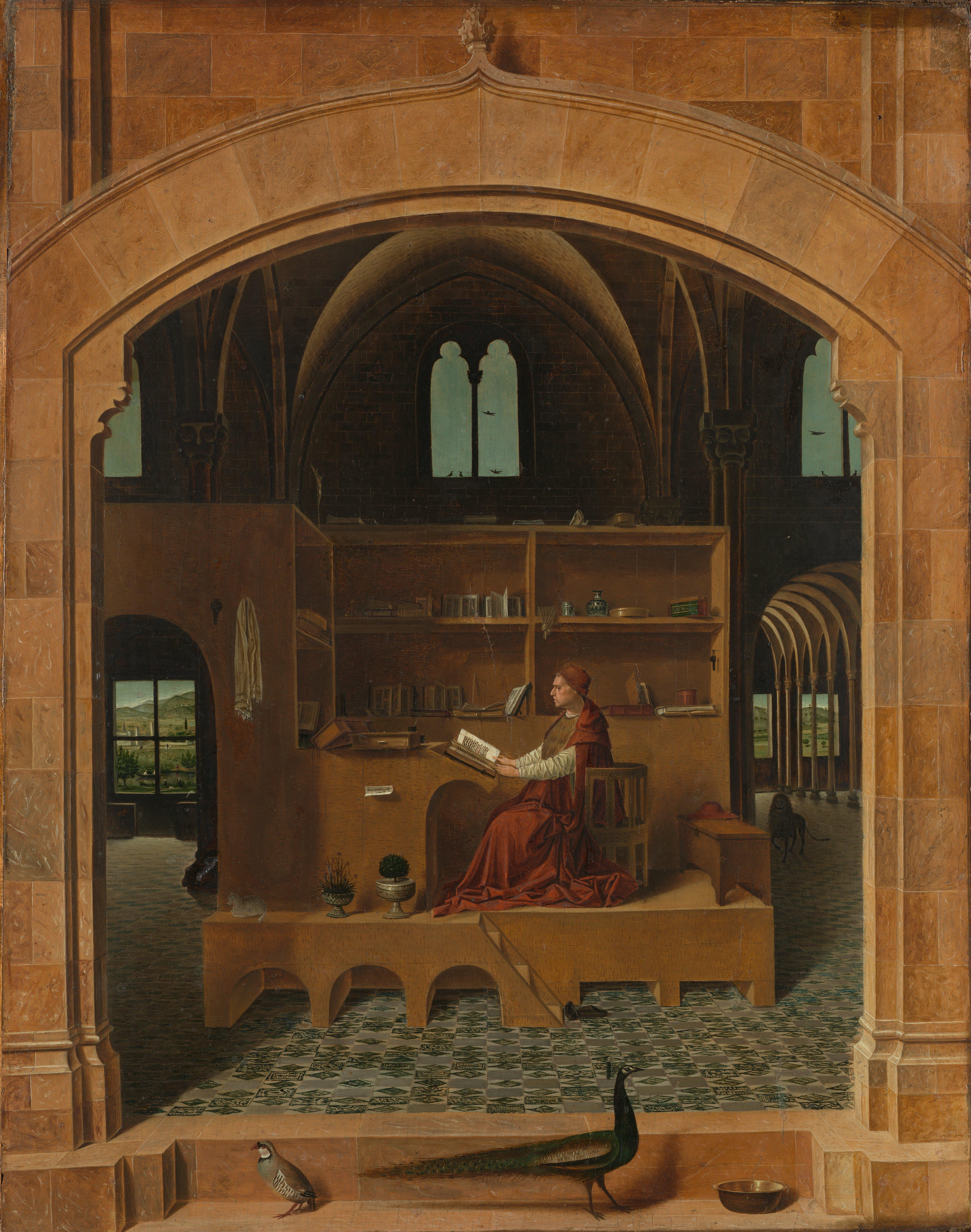
Find where the peacock’s feet rest. Compare the stone beneath the bird with the tiles behind it to distinguish the two planes.
Find the silhouette beside the columns. The lion, Jerome’s traditional companion, helps identify the reader.
Look closely
Begin with the scale of the figure. Beneath the high vaults, Jerome occupies a small raised wooden study with its own steps and shelves. Dressed in red and shown in profile, he inclines his head slightly towards the pale pages of the book. On the right, between the columns, the aisle recedes towards a bright opening.
Understanding
Giving concentration a visible form
Antonello sets a workspace built to human scale within an almost monumental interior. The wooden study forms a room within a room. A few steps are enough to mark out the space where Jerome withdraws to devote himself to study.
The aisle draws our eye into the distance. Jerome’s gaze stays fixed on his book. By placing so many things around a man who gives his full attention to just one, Antonello makes concentration the subject of the painting.
The arch and sill still situate us at the entrance. From there we can make out an open book, objects on the shelves and a man absorbed in reading. Antonello builds the space around what defines Jerome: the study of texts and the concentration it requires.
Pietà — The Dead Christ Supported by an Angel
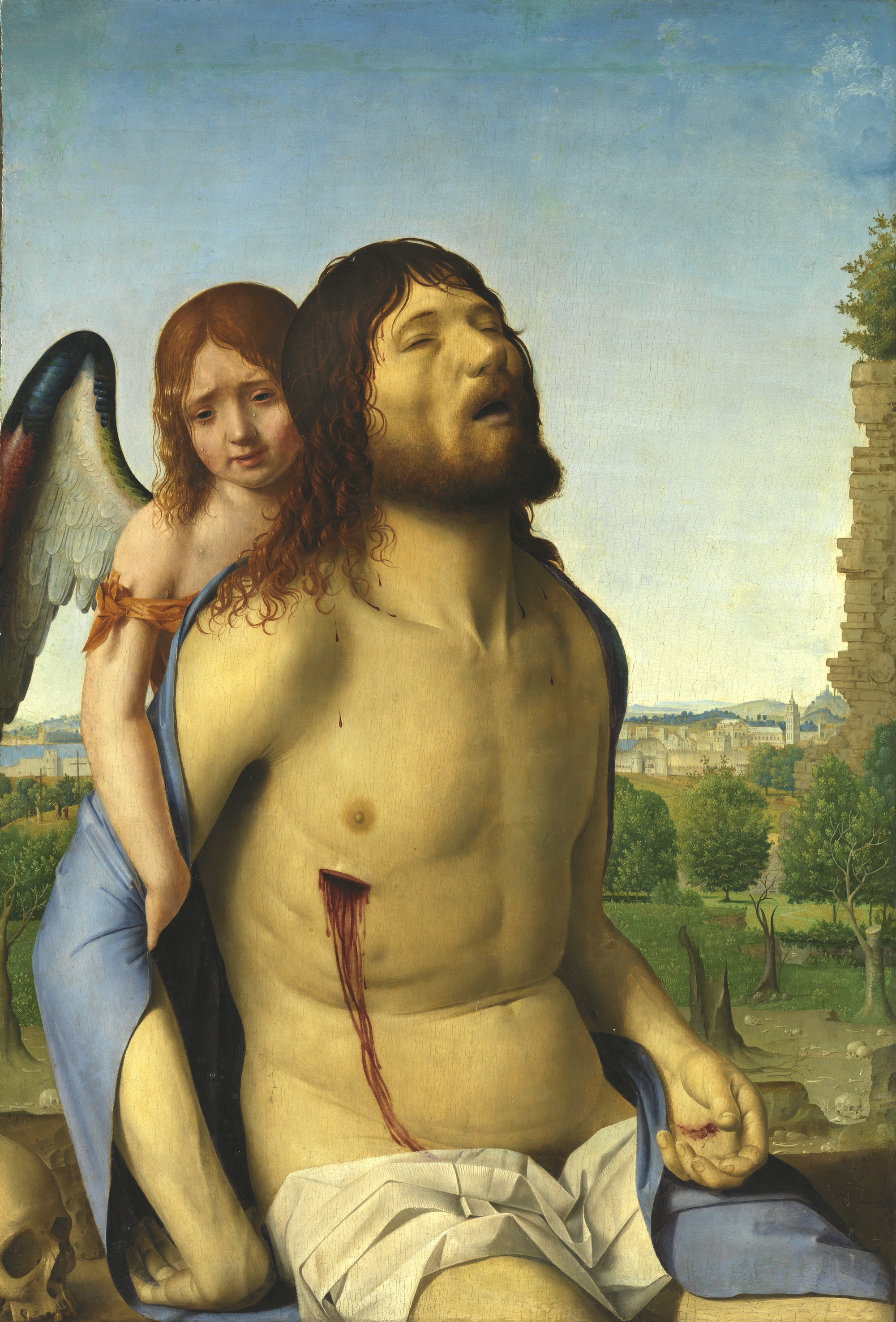
Follow the line towards the bottom of the panel. The length of the falling arm gives a sense of the body’s weight.
Find the hand in the oval between the blue fabric and the arm. This small area of contact reveals the angel’s physical role.
On either side of the figures, find where the distant landscape meets the sky. The horizon lies well below their faces. The small buildings in the distance emphasise the scale of Christ’s body in the foreground.
Look closely
Look at the two heads. Christ’s falls back, his mouth slightly open. Just behind his shoulder, the angel inclines his face. His brows draw together and his eyes lower. Follow Christ’s arm down the left side of the painting. It hangs all the way to the lower edge. Look behind it for the angel’s smaller hand supporting him.
Now look at the horizon. It runs well below the two faces. A distant town comes into view between the trees and the sky.
Understanding
Giving compassion the form of a gesture
Antonello conveys Christ’s weight through the way his body gives way. The arm hangs loose, the head falls back, and the angel has to hold him up from behind. The angel’s small hand gives us a concrete sense of that effort. His bowed face, so close to Christ’s, makes grief visible alongside the act of support. wga.hu
The landscape gives this closeness its force. The town and trees, made small by distance, emphasise the scale of the torso in the foreground. Antonello brings us close to a gesture we can recognise and whose effort we can imagine. In this devotional image, compassion takes the form of a human action, holding up a body that can no longer support itself.
How to recognise Antonello de Messine?
Outlines absorbed into shadow
See where a cap or garment merges with the background. The outline can disappear in places while the transitions of light still give volume to the face.
An object that sets the distance
Look for the edge of a piece of furniture or a ledge at the bottom of the panel. Its angle often helps you work out where the scene is viewed from.
A story told through touch
Isolate the point where a hand meets a body or garment. See whether you can reconstruct the whole gesture from that contact.
Details at two distances
First take in the overall structure from a distance. Then move closer and see which small detail clarifies the setting or identifies the figure.
Key takeaways
Antonello’s contribution is a way of making a figure’s inner life felt through remarkably few signs. A comparison with Fra Angelico brings out what is distinctive about his approach. At San Marco, Gabriel and Mary face each other beneath a portico. In the Palermo panel, Antonello builds the whole scene around Mary. The direction of her gaze and the movement of her hand suggest Gabriel’s presence. Part of the story thus takes shape beyond the frame.
The same approach connects all four works on this page. The Condottiere’s gaze makes us feel he has just noticed us. Jerome’s book absorbs his full attention. In the Pietà, the angel’s hand supporting Christ gives his compassion a tangible form.
In Antonello’s paintings, a single visible detail is often enough to make us imagine what a figure feels.
Poursuivre la découverte
See how the setting connects Gabriel and Mary in Fra Angelico’s painting. In the Palermo panel, consider how Antonello gives the exchange a direction while showing Mary alone.
Compare the threshold of Jerome’s study with the lines of the pavement in Piero’s Flagellation. Each painter uses architecture to establish a viewpoint.
Pour aller plus loin
After tracing the route from the threshold to the desk, listen to this France Inter episode for another reading of the painting.